Skip to content





The clearest signs your fish tank water quality is declining are fish gasping at the surface, sudden lethargy, refusing food, cloudy or discolored water and an odor from the tank. Most trace back to rising ammonia or nitrite, falling oxygen or a filter that has fallen behind. The Merck Veterinary Manual says poor water quality is the most common cause of environment-related disease in fish, and the RSPCA advises checking your water quality first. A water test tells you which problem you have faster than watching and waiting.
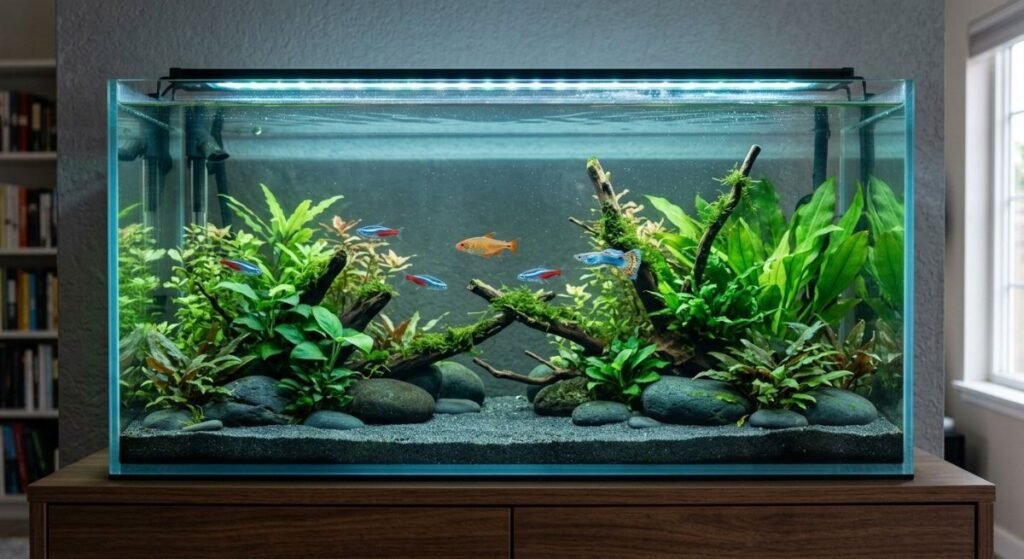
The Part of Fish Tank Water Quality You Cannot See
- Ammonia builds up constantly, because fish waste and leftover food break down into it. Merck describes it as highly toxic with prolonged exposure.
- Bacteria living in the filter media convert ammonia into nitrite, which Merck notes is also toxic in high amounts, and then into nitrate, which is much less toxic.
- That conversion depends on a stable bacteria colony. Overfeeding, a jump in fish numbers or scrubbing the filter too hard can knock it off balance.
- None of this shows up as a color change. The RSPCA notes that clear water does not mean healthy water, and says safe levels of both ammonia and nitrite are 0 mg/L.
The signs below are how your fish and tank respond to the chemistry, not the chemistry itself.
Fish Gasping or Clustering at the Surface
Check this one first. The RSPCA says a fish continuously gulping and gasping at the surface signals oxygen starvation or poor water quality. (Labyrinth fish such as gouramis, which breathe air, are an exception.)
- Temperature. Merck notes that warmer water holds less oxygen and that water that gets too warm can suffocate fish. Check the thermometer, and keep the tank out of direct sunlight.
- Ammonia and nitrite. Test both next. Elevated levels stress fish even when the water looks fine.
- Filter flow. Weak flow reduces surface movement, which helps oxygen enter the water. Check it at the same time.
Lethargy or Sudden Hiding
A fish that stops swimming, sits at the bottom or disappears behind decor is stressed. Lethargy is on Merck’s list of common signs of illness in fish, and the RSPCA notes that a change in activity level can point to a problem, including a temperature change. Water quality is one common cause, but not the only one.
The pattern matters more than the behavior. Several fish going quiet together points toward the tank. One fish acting differently while the rest look normal points more toward illness or a conflict with tankmates.
Refusing Food
Healthy fish show up for food, and the RSPCA lists eager eating as a sign of a healthy fish. If several stop eating over a few days, test the water before assuming it is a phase. A single fish refusing food while the rest eat normally is more likely about that fish.
Cloudy or Discolored Water
Cloudiness is common in a new tank while the biological filter establishes itself. If your tank is new, see how to cycle a new fish tank to tell normal cycling from an actual problem. New cloudiness in a tank that has been running fine means something changed.

Color alone does not confirm the cause, but it narrows down where to look:
| Water appearance | Likely cause | What to check |
|---|---|---|
| White or gray haze | Bacterial bloom, often linked to overfeeding | Ammonia, nitrite |
| Green tint | Algae bloom | Light duration, direct sunlight, nitrate |
| Brown or yellow tint | Tannins from driftwood or organic buildup | Water change schedule, decor |
| Cloudy with no obvious trigger | Filter behind on the tank’s waste load | Filter flow and condition |
An Odor From the Tank
A healthy tank barely smells. A sulfur note, an ammonia edge or a general rotten smell usually means waste is decaying faster than the filter can process it. Common sources include food trapped in the substrate, a fish or snail that died out of sight and a filter overdue for cleaning. By the time you smell it, the problem has often been building for a while.
A Sudden Jump in Algae
Some algae is normal. A sudden increase often means nutrients are building up because waste is outpacing your cleaning routine. According to Merck, plants absorb nutrients that would otherwise feed algae, direct sunlight encourages algae, and leaving the lights on 24 hours a day stresses fish and makes them more disease-prone. If growth increased and lighting did not change, test the water before blaming the light.
What to Do Once You Notice One of These
- Test before touching anything else. Ammonia, nitrite, nitrate and pH cover most problems on this page. Check the temperature too.
- Do a partial water change. If ammonia or nitrite reads above zero, the RSPCA advises changing half the water and repeating daily, with testing, until levels improve. Treat new water with a dechlorinator and match its temperature to the tank.
- Skip the full water change and the aggressive filter scrub. Both can wipe out the bacteria colony the tank depends on, which tends to make things worse over the following days. If the filter is part of the problem, how to clean a fish tank filter walks through it safely.
- Fix the cause. Reduce feeding, remove uneaten food, check the filter and lighting, and review how often you do maintenance. How often to clean a fish tank gives a starting schedule.
Goldfish produce more waste relative to their size than most community fish, which how often to clean a goldfish tank covers on its own.
When It Is Not the Water
Ammonia, nitrite and pH can all test normal and a fish can still be gasping, lethargic or off its food. The RSPCA lists other signs of illness, including pale patches or sticking-out scales, tiny white spots, a milky eye, a swollen or sunken belly and swimming to one side. A water test cannot diagnose these. Contact a vet who treats fish, and see the RSPCA’s fish care advice for more.
Fish Tank Water Quality FAQ
Can a tank look completely normal and still have bad water quality?
Yes. Ammonia and nitrite are invisible, and the RSPCA says clear water does not mean healthy water. Visual signs often appear after the chemistry has already shifted.
How fast can water quality decline?
It depends on the tank. A filter failure, overfeeding or a sudden increase in fish can raise ammonia within days, especially in smaller tanks with less water to dilute waste. A slower decline from skipped maintenance can take weeks to become noticeable.
How often should I test my aquarium water?
Both Merck and the RSPCA suggest testing about every two weeks for an established tank, and more often in a new tank or after problems appear. Merck recommends daily ammonia and nitrite checks when a new tank is stocked.
Do all fish show the same signs of poor water?
No. Species differ in what water conditions they tolerate, and some, such as gouramis, breathe air at the surface normally. Learn the normal behavior of your species so changes stand out.
Last reviewed: October 2026.