Skip to content




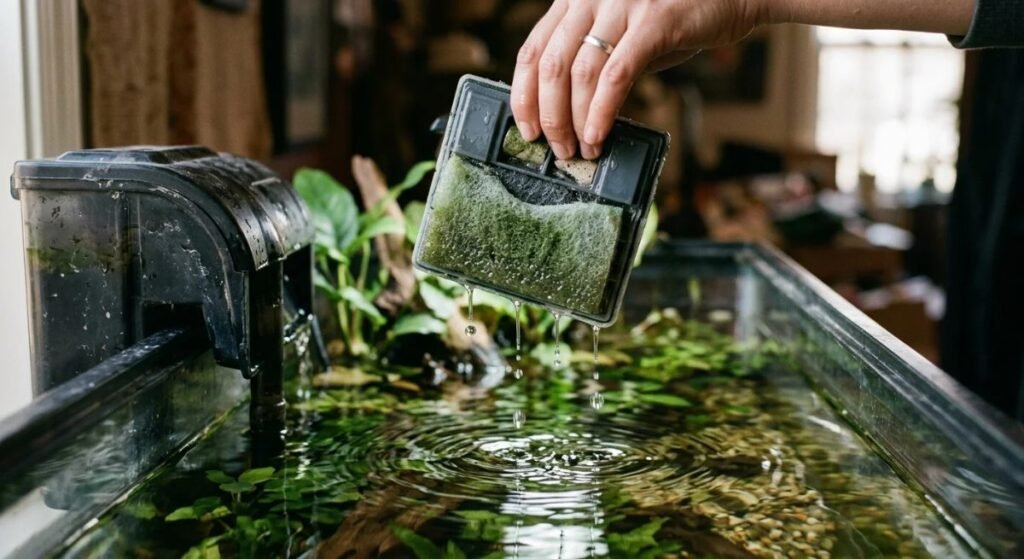
There is no single schedule that suits every tank. A good rule is to check your fish tank filter about every two weeks, and clean it only when the flow has dropped or the media is clogged. The Merck Veterinary Manual lists checking filter flow every two weeks and cleaning if needed, replacing filter cartridges monthly or sooner if clogged, and replacing carbon every one to three months. How often you actually clean depends on the filter type, how many fish you keep, how much you feed and how the filter is performing right now.
Mechanical media (sponges and floss that trap debris) usually needs rinsing every few weeks as a rough starting point. Biological media (ceramic rings, bio-balls) is different. Leave it alone unless flow has dropped noticeably, because it provides much of the surface where beneficial bacteria live.
Why Filter Cleaning Frequency Varies So Much
Two tanks with the same filter can need completely different schedules. A few things drive that:
- Fish load. More fish means more waste. Merck notes that too many fish added at once overwhelm the beneficial bacteria. Goldfish are heavy producers of waste; see how often to clean a goldfish tank.
- Feeding. Overfeeding adds to the load the filter has to handle, because uneaten food breaks down into ammonia.
- Tank size. Smaller volumes concentrate waste faster, so the filter works harder between water changes.
- Filter type. A canister filter holds more media, so debris has room to spread out before flow suffers. A compact internal filter clogs faster because it has less media.
None of this fits a fixed interval. Flow rate and the look of the media tell you more than counting weeks.
Signs a Filter Needs Cleaning
Check these regularly instead of waiting for something to go visibly wrong:
- Flow from the outlet or spray bar is noticeably weaker than usual
- Sponge or floss media looks packed with brown or gray sludge
- Water takes longer than normal to clear after a water change
- Ammonia or nitrite readings climb even though feeding has not changed
- The filter motor makes a new grinding or humming noise
Reduced flow is usually the clearest signal. If the outlet used to push a strong current and now barely trickles, the mechanical media is probably clogged. That is a more reliable cue than any date on a calendar. If ammonia or nitrite appears, see signs your fish tank water quality is declining.
Can You Clean a Fish Tank Filter Too Often?
Yes, and it is a more common mistake than people expect. A filter does more than trap debris. Its media gives beneficial bacteria a surface to colonize, and those bacteria drive the nitrogen cycle that converts toxic ammonia into nitrite and then into much less toxic nitrate. A technical aquaculture guide from the Southern Regional Aquaculture Center describes the biofilter as the main site of this conversion.
Scrubbing a filter until it is spotless can remove much of that bacteria colony along with the grime. How much it matters depends on the tank. An older, lightly stocked aquarium may cope better, because bacteria also grow on other surfaces. A newer or heavily stocked tank has less buffer, and ammonia or nitrite can rise as if the tank were cycling for the first time (see how to cycle a new fish tank). The aim is not to make the filter look new. It is to keep it working.
How to Clean a Fish Tank Filter Without Killing the Bacteria
- Do it during a water change. Siphon out a bucket of tank water before you refill. You will rinse the media in it.
- Rinse mechanical media in that tank water. The RSPCA advises swishing the filter sponge in water removed from the tank, never under the tap, because tap water can kill the beneficial bacteria. Merck notes that chlorine and chloramine in tap water are toxic to both fish and the bacteria. This clears trapped debris and leaves most of the colony intact.
- Leave biological media mostly alone. Ceramic rings and bio-balls need the least interference. A light swish in tank water is reasonable if flow is genuinely restricted. Full replacement is rarely necessary.
- Clean the housing, impeller and intake separately. These parts host little bacteria colony. The RSPCA lists cleaning the impeller as part of filter upkeep, and a dirty impeller shaft is a common cause of grinding or humming noises.
- Put everything back and check the flow. Confirm the water is moving properly, and do not turn the filter off for longer than you need to.
Cleaning vs. Replacing Filter Media
These are different jobs. Cleaning rinses existing media to clear debris while keeping most of the bacteria. Replacing discards the media and starts again, which resets part of the tank’s biological filtration at once.
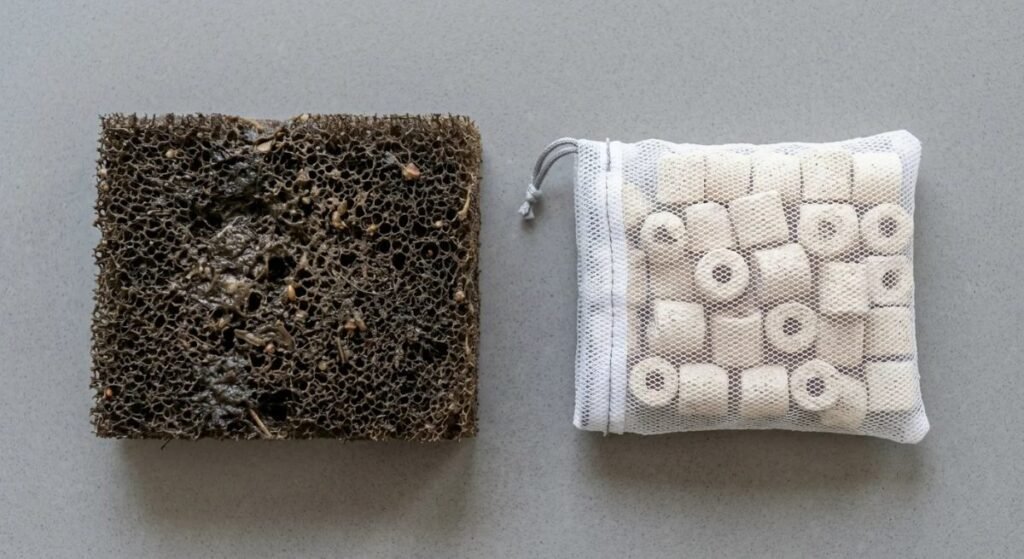
Filter floss carries little bacteria colony, so replacing it fairly often is not a major concern. Biological media should rarely be fully replaced. If you must replace it, a common approach is to swap part of it at a time, spaced weeks apart, so bacteria can establish on the new material before the old is removed.
Disposable cartridges are where advice differs. Merck recommends replacing cartridges monthly or sooner if clogged, and some manufacturers say the same. Other keepers rinse the same cartridge repeatedly to preserve more bacteria. Stocking level and filter design both matter, so there is no single rule. Carbon is different: Merck suggests replacing it every one to three months, since it stops working over time.
Does Every Filter Type Need the Same Approach?
No. What to check and how often varies by design:
| Filter type | What to check | Typical maintenance trigger |
|---|---|---|
| Hang-on-back (HOB) | Flow from the outlet, cartridge condition | Noticeably weaker flow or a visibly clogged cartridge |
| Canister filter | Flow rate, media clogging (checked less often) | Reduced flow; larger media volume takes longer to clog |
| Sponge filter | Sponge texture and color | Sponge feels heavily saturated or flow through it slows |
| Internal power filter | Flow output, intake for debris | Flow drops or the intake shows visible buildup |
A Practical Way to Approach It
Check the filter during a routine water change instead of on a separate schedule. Look at the flow, glance at the mechanical media and rinse only what needs it. If the sponge is packed with sludge or the outlet has slowed, that is your cue. If everything still looks and runs normally, there is no reason to disturb it. For a full tank routine, see how often to clean a fish tank.
Fish Tank Filter Cleaning FAQ
How often should you clean a fish tank filter?
Check it about every two weeks and clean only when flow drops or media is clogged. Many tanks need mechanical media rinsed every few weeks, and some need it less often.
Can you clean a fish tank filter too often?
Yes, especially if biological media is scrubbed or replaced all at once. The risk depends on how established and how heavily stocked the tank is.
Should filter media be rinsed in tap water?
No. Use water removed during a water change. The RSPCA advises against rinsing filter media under the tap, because chlorine and chloramine can harm beneficial bacteria.
How do you know when a filter sponge needs cleaning?
Weaker flow from the outlet and visibly clogged, discolored sponge are the two clearest signs. Waiting for a set date is not a reliable substitute for checking.
Should you clean or replace biological filter media?
Clean it when possible. It holds much of the tank’s bacteria colony, so replacing it outright removes more than a rinse would, and it is rarely needed unless the media is physically breaking down.
How often should I replace filter carbon?
Merck suggests every one to three months. Carbon does not need to be part of every filter setup, so follow your filter’s instructions.
Last reviewed: October 2026.