


Most established freshwater tanks do well on a weekly partial water change, with algae and debris wiped away whenever you notice them. That’s the starting point. What actually keeps your tank healthy is adjusting from there based on how many fish you keep, how much you feed them, how your filter is holding up, and what your water tests are telling you. Clear water isn’t proof that any of that is fine. It just means the water is clear.
A starting schedule, and when to move off it
No single calendar works for every aquarium. A large tank with a handful of fish and strong filtration can often go longer between real maintenance than a small tank carrying a heavy fish load, which may need attention more than once a week.
Still, for a typical established freshwater community tank, this is a reasonable baseline:
| Maintenance task | Starting point | Adjust when… |
| Partial water change | About once a week | Water tests, stocking, or waste buildup say otherwise |
| Substrate cleaning | During water changes | Debris is collecting fast in specific spots |
| Glass and algae cleaning | As needed | Algae builds up quickly or blocks your view |
| Filter inspection | Every maintenance session | Water flow noticeably slows |
| Filter media cleaning | When clogged or flow drops | Frequency varies by filter and bioload |
| Water testing | Regularly | More often in new or unstable tanks, or if ammonia or nitrite shows up |
Spotless isn’t the goal here. Beneficial bacteria live on the filter media and other surfaces, quietly turning waste into less harmful stuff, and scrub the tank too hard or too often and you’re fighting your own filtration system instead of helping it along.
What “cleaning the tank” actually means
The phrase covers several distinct jobs: swapping out some water, scraping algae, vacuuming the substrate, checking the filter. A normal maintenance session touches most of these at once. Remove some old water, siphon debris out of the substrate, scrape the glass, pull any dead plant material, confirm the filter is still moving water properly.
What it shouldn’t involve, for an established tank, is emptying everything and scrubbing down to bare glass. That kind of deep clean strips out the biological filtration you’ve spent weeks building.
How much water, how often
A partial water change dilutes accumulated waste and replaces it with fresh, conditioned water. There’s no fixed percentage that fits every tank. Stocking, feeding, filtration, plants, and how fast waste tends to build up all factor in.
Weekly partial changes work fine as a default for most freshwater tanks. Your water tests will tell you whether that’s actually keeping pace, or whether you need to change more, less, or more often. And if your tap water has chlorine or chloramine in it, treat it with a conditioner before it goes in, matching the new water’s temperature to the tank’s so the fish aren’t hit with a sudden shift.
Signs your tank needs more frequent attention
- Waste or uneaten food building up faster than usual
- Algae returning quickly or spreading across large areas
- A heavily stocked tank
- Fish being fed often or in large amounts
- Weaker filter flow than normal
- Rising ammonia, nitrite, or nitrate on a test
- A tank that’s small relative to the number or size of the fish in it
- Cloudiness that keeps returning even after cleaning
Stocking density often matters more than tank size alone. Goldfish are the clearest example: they produce enough waste that keeping their water in good shape takes more work than a lightly stocked community tank. If that’s your setup, see How Often Should You Clean a Goldfish Tank? for specifics.
Why clear water can still be a problem
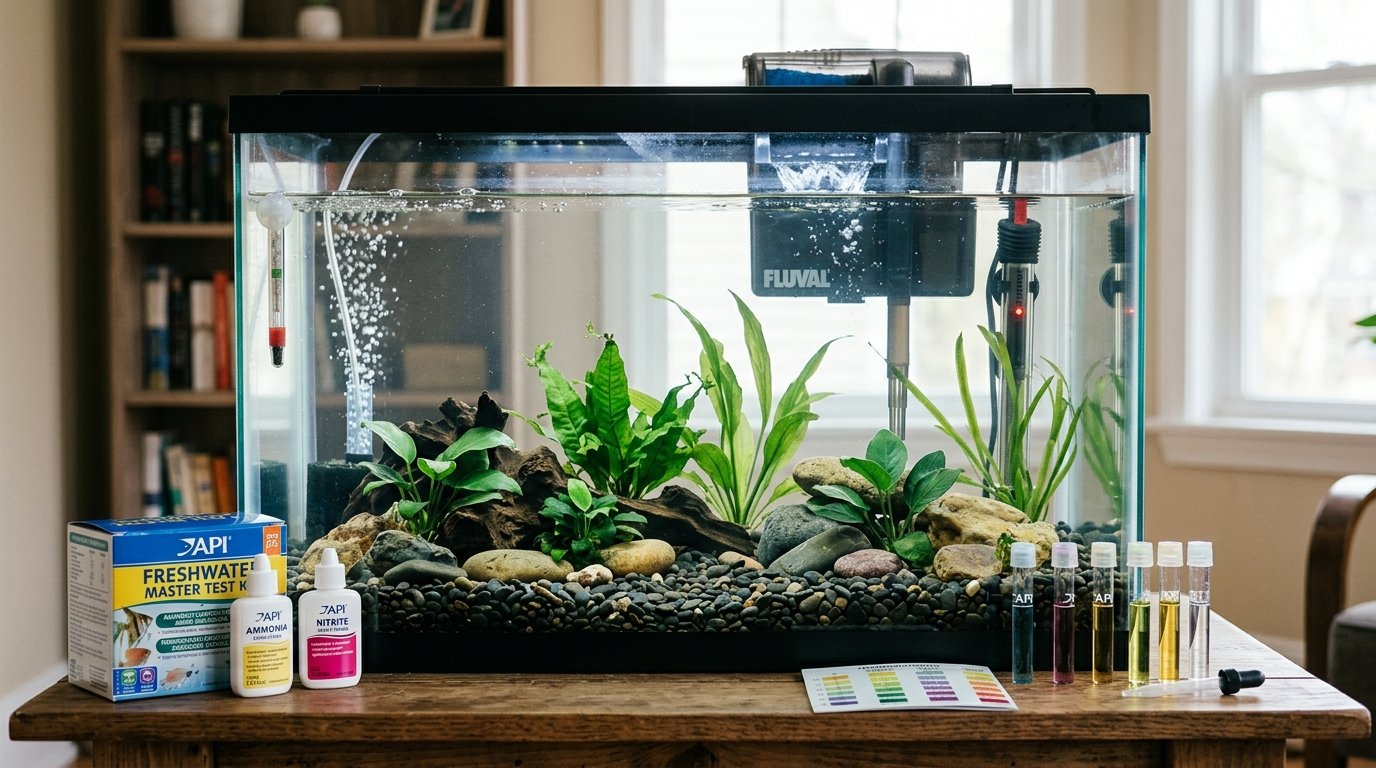
Ammonia and nitrite don’t change the color of the water or make it look any different. The Merck Veterinary Manual flags both as major water-quality concerns and points to testing the water directly rather than judging by appearance. So if your fish seem a little off but the tank looks completely normal, grab a test kit before you grab a glass scraper. It’ll tell you a lot more.
For an established freshwater tank, the numbers worth keeping an eye on are ammonia, nitrite, nitrate, pH, and temperature. Newer tanks need even closer watching, since they haven’t built up the same buffer in their biological filtration yet.
If you’re noticing behavior changes in your fish, Signs Your Fish Tank Water Quality Is Declining covers what else to look for.
How to clean without disrupting the biological filter
Test first. This comes before scraping or siphoning anything. Ammonia and nitrite deserve particular attention in a newer tank or one recently disrupted by a big cleaning or a newbatch of fish. If either reads detectable, that calls for figuring out the cause, not waiting for the next scheduled clean.
Clear algae and visible debris. An aquarium-safe scraper handles the glass. Pull out obvious uneaten food, waste clumps, and dead plant material. Some algae film and organic matter is normal in a living system; the aim is control, not sterility.
Vacuum the substrate. A gravel vacuum pulls debris out while removing water for the change at the same time. Focus on where debris actually collects rather than disturbing the whole substrate bed every session, especially in a planted tank where the substrate is also supporting root growth.
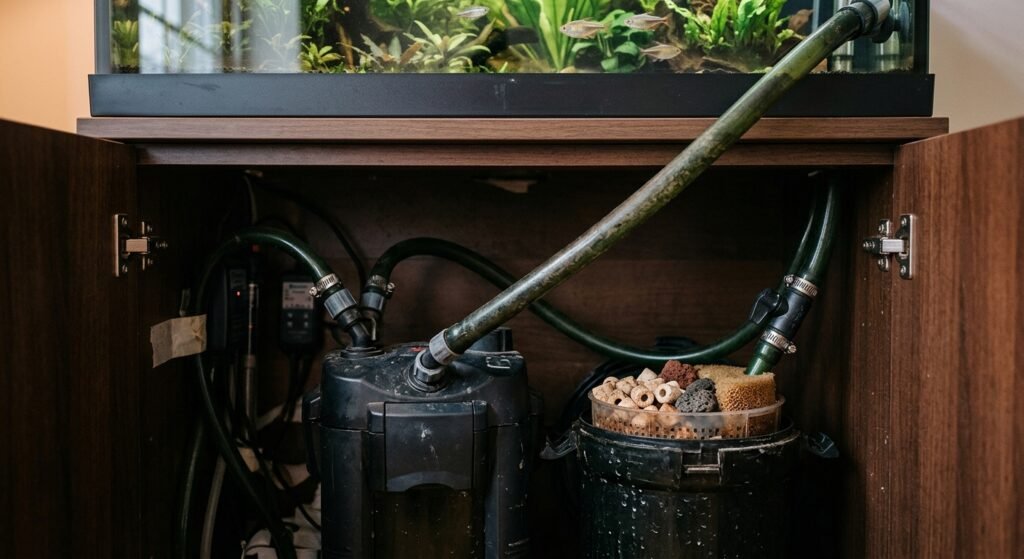
Check the filter. Mechanical media needs cleaning once it’s clogged or flow drops. Biological media is a different matter: it’s covered in the bacteria doing the real work of the nitrogen cycle, and it needs a much gentler touch. For the full breakdown, see How Often Should You Clean a Fish Tank Filter?
Refill slowly. Use conditioned water matched to the tank’s current temperature, poured against a decoration or the glass rather than straight down, so you’re not blasting the substrate or plants apart.
Why a full scrub-down usually backfires
A healthy aquarium was never supposed to be germ-free. All those bacteria living on the filter media and other surfaces are busy turning ammonia into something far less harmful, and if you scrub everything down or swap out all the biological media in one go, you wipe out weeks of that work in a single afternoon. Good maintenance stays targeted instead. Pull out the waste, keep algae from taking over, refresh some of the water, and only touch the equipment when it actually needs it.
A brand-new tank is a different story, since there’s no bacteria colony built up yet to worry about protecting. If you’re starting from scratch, How to Cycle a New Fish Tank Before Adding Fish covers that groundwork.
When your fish are telling you something’s off
Gasping at the surface, moving slower than usual, ignoring food. These are all things fish do when the water’s off, but they won’t tell you which problem you’ve got. So test first. Don’t just scrub the tank and hope. If you find ammonia or nitrite, chase down the source. And if your fish are still struggling once you’ve dealt with an obvious water issue, it’s time to call a vet who actually knows fish.
A realistic routine, not a rigid one
Weekly: check the fish and equipment, test the water, clear visible debris and excess algae, and do a partial water change sized to what the tank needs.
Every session: look at the substrate and filter. Clean mechanical media when it’s clogged or restricting flow, not on a fixed schedule.
On an ongoing basis: test the water, more often in new or unstable tanks than in ones that have been stable for months.
Whenever something changes: re-evaluate after adding fish, increasing feeding, adjusting filtration, adding plants, or noticing more waste or algae than usual.
The best routine isn’t the one with the most scrubbing. It’s the one that keeps water stable without constantly disturbing the system doing the actual work.
FAQ
How often should you clean a fish tank?
Weekly partial water changes plus routine debris removal work well for most established freshwater tanks. Heavily stocked tanks, goldfish tanks, and tanks already showing water-quality problems typically need more frequent attention.
Should you completely empty a fish tank when cleaning it?
No, not for routine maintenance. Partial water changes and targeted cleaning handle it. Fully draining and scrubbing an established tank tends to disturb the biological filtration more than it helps.
How often should I change the water in my fish tank?
Weekly is a practical starting point for many freshwater tanks. The right frequency depends on stocking, feeding, filtration, plants, and what your water tests show, and there’s no single percentage that fits every setup.
Can you clean a fish tank too often?
Yes. Repeatedly disturbing the substrate or aggressively washing and replacing biological filter media can work against you. Regular water changes and targeted maintenance are a different thing entirely from stripping the tank down.
How do I know if my fish tank needs cleaning?
Watch for building waste, fast-spreading algae, weaker filter flow, recurring cloudiness, and worsening water-test results. Fish behavior can also be a signal, but clear water alone never confirms the chemistry is safe.
Does a new fish tank need to be cleaned differently?
Yes. A new tank hasn’t built up mature biological filtration yet, so ammonia and nitrite can spike while that develops. Testing and appropriate maintenance matter even more here than in an established tank.