Skip to content





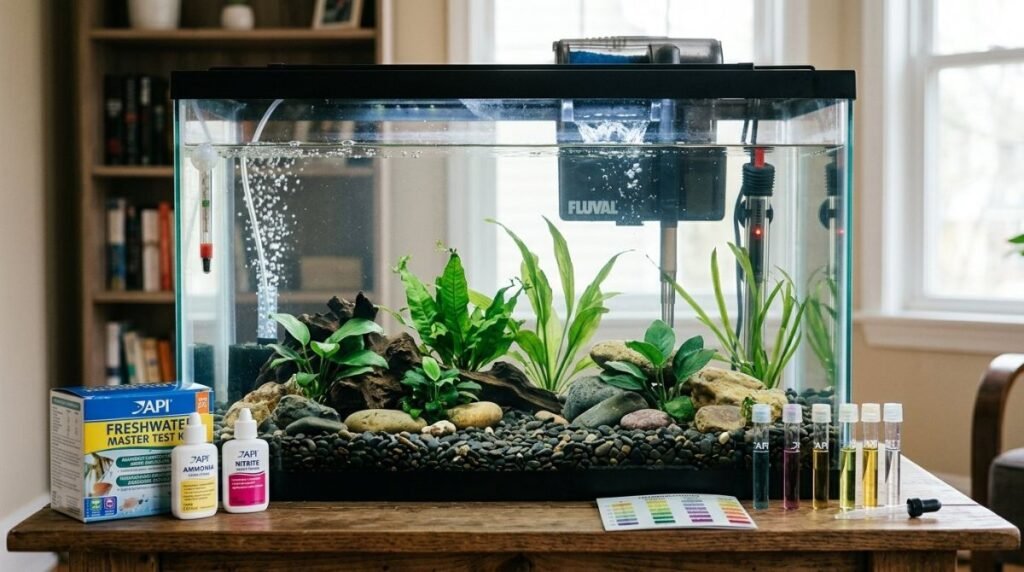
How to cycle a new fish tank: run the filter and add a small source of ammonia (without fish) until beneficial bacteria grow and both ammonia and nitrite test at zero. This is called fishless cycling, and it protects your fish from the toxic spikes that happen in an uncycled tank. The RSPCA says to add fish only after ammonia and nitrite have spiked and then returned to zero, which takes at least two weeks, and the Merck Veterinary Manual says the bacteria develop on their own in about four to six weeks. Don’t go by the calendar alone: test the water.
A brand-new tank looks ready, with clear water, a humming filter and tidy decorations, but it has none of the bacteria that keep fish alive. Adding fish too early is one of the most common beginner mistakes. It is often called “new tank syndrome,” and it is preventable.
What “Cycling” Actually Means
Fish waste and uneaten food break down into ammonia, which is highly toxic to fish even in small amounts. In an established aquarium, bacteria living mostly in the filter media convert it in two steps:
- One group of bacteria converts ammonia into nitrite, which is also toxic to fish.
- A second group converts nitrite into nitrate, which is far less harmful and is removed by water changes. According to Merck, nitrates are much less toxic and can also be used by plants and algae.
This is the nitrogen cycle (see Britannica’s overview), and “cycling a tank” means growing enough of both groups before fish depend on them. Bacteria do not appear overnight. They need ammonia to feed on and time to multiply, and a brand-new tank has neither.
Set the Tank Up as if Fish Already Live There
Before you add any ammonia source, get the tank into its final state:
- Install the filter, heater and any air pump or other equipment.
- Fill the tank with dechlorinated water. Merck notes that most city water contains chlorine or chloramine, which are toxic to fish and to the beneficial bacteria, so treat any new water with a dechlorinator.
- Rinse new gravel and decorations with plain water. Skip soap, which can leave harmful residue.
- Turn the filter on and leave it running continuously. The bacteria live in the filter media and need constant oxygenated water flow.

You will also want a liquid test kit that measures ammonia, nitrite, nitrate and pH. Liquid kits are generally considered more accurate than test strips. Keep the tank at the temperature your future fish need. Stability matters more than hitting an exact number, since bacteria and fish both dislike swings.
Fishless Cycling: The Safer Way to Cycle a New Fish Tank
You do not need fish to cycle a tank. Putting fish in an uncycled tank exposes them to exactly the ammonia and nitrite spikes cycling is meant to avoid. With fishless cycling, you feed the bacteria yourself, and no animal is exposed to the toxic phase.
There are two common ammonia sources:
- Pure ammonia made for cycling. The better option, because dosing is more precise and predictable.
- Fish food left to decay. It works, but you cannot control how much ammonia it produces or when, and it can take longer.
If you use a bottled ammonia product, follow the label dosing exactly. Do not add extra “just in case.”
How to Cycle a New Fish Tank, Step by Step
- Start with treated water and running equipment. Dechlorinate the water and confirm the filter and heater are working before you add anything else.
- Add your ammonia source. Follow the product label, or add a small, controlled amount of fish food.
- Test every couple of days and log the results. The RSPCA suggests testing every other day while cycling. At first you will mostly see ammonia, which is normal.
- Watch for the first shift. As the first bacteria establish, ammonia falls and nitrite rises.
- Watch for the second shift. Nitrite starts to fall and nitrate appears. When nitrite is consistently dropping to zero, you are close.
- Do not rush the finish. Running the filter for a week or two and calling it done is a common reason “cycled” tanks crash once fish arrive. Merck puts natural cycling at around four to six weeks, and it can take longer depending on tank size, water source and equipment.
- Confirm with your test kit before buying fish. Ammonia and nitrite should both read 0 on the same day.
| Test | What you may see mid-cycle | What you want before adding fish |
|---|---|---|
| Ammonia | Rises, then falls as bacteria establish | 0 mg/L (ppm) |
| Nitrite | Appears once ammonia drops, then falls | 0 mg/L (ppm) |
| Nitrate | Appears as nitrite is processed | Present at a low, steady level is normal; keep it in check with water changes |
| pH | May shift during the process | Stable and suitable for your species |
Why Clear Water Tells You Nothing
Clear water does not mean the tank is cycled. Ammonia and nitrite are invisible, and a tank can look flawless while being toxic. The RSPCA makes the same point: clear water does not mean healthy water. The only reliable way to know is to test, not to eyeball the tank or count days.
Cloudy water is a separate issue, often a bacterial bloom as the microbial community establishes, and it is not a reliable sign of cycling either way.
What Throws a Cycle Off Track
- Untreated tap water in top-offs or water changes. Chlorine and chloramine harm the bacteria as well as fish.
- Rinsing filter media under the tap. The RSPCA advises swishing media in tank water instead, because tap water can kill beneficial bacteria.
- Replacing all filter media at once. This removes most of the bacteria you have been growing, so replace media gradually.
- Chasing a perfect pH. Frequent chemical adjustments tend to destabilize the tank more than a steady, slightly imperfect pH.
- Overdosing ammonia. More ammonia does not speed things up and can stall the cycle.
Adding Your First Fish
Once ammonia and nitrite both read zero consistently and temperature and pH suit your species, you can add fish, but go slowly. The bacteria have grown to match the ammonia you fed them, not necessarily a full tank of fish. Merck notes that if you stock a new tank all at once, you may need to check ammonia and nitrite daily and control rises with frequent water changes.

- Add fish in small batches, not your whole planned stocking list at once.
- Re-test a few days after each addition.
- If ammonia or nitrite appears, do a partial water change and hold off on more fish until the readings are stable.
When you add fish, Merck suggests floating the transport bag for 20 to 30 minutes to equalize temperature, and not pouring the bag water into the tank.
Keeping the Tank Cycled Long-Term
A finished cycle needs upkeep:
- Keep the filter running around the clock.
- Do not overfeed, since excess food adds to the ammonia load.
- Do regular partial water changes to keep nitrate in check. See how often to clean a fish tank for a schedule.
- Replace filter media gradually. How to clean a fish tank filter explains how to do it without wrecking the bacteria.
- If fish behave oddly or the water turns cloudy, test the water before assuming you need a deep clean. Signs your water quality is declining covers what else to watch for.
Goldfish produce a heavier waste load than most community fish, so give them extra attention to filtration and stocking density. See how often to clean a goldfish tank.
Fish Tank Cycling FAQ
How long does it take to cycle a fish tank?
The RSPCA says at least two weeks, and Merck puts natural bacterial growth at roughly four to six weeks. Some tanks take longer, so go by test results, not the calendar.
Can I cycle a tank with fish in it?
You can, but the fish are exposed to ammonia and nitrite along the way. Fishless cycling avoids that risk.
Ammonia is at zero. Can I add fish now?
Not yet. Nitrite must read zero as well. Many tanks look done at the ammonia stage but are still mid-cycle on nitrite.
Do I need bottled bacteria to cycle a tank?
Not strictly. Merck says commercial starters are not necessary for most home tanks, because the bacteria develop on their own. Bottled products may help in some cases, but they do not replace testing.
It has been five weeks and nitrite is still not zero. What is wrong?
Not necessarily anything. Some tanks take longer, especially larger ones or those with poor water flow. Check that the filter is running properly and the water is fully dechlorinated. If readings still look odd, ask an aquatic vet or experienced fish-store staff.
My tank has live plants. Do I still need to cycle it?
Yes. Plants absorb some nitrogen compounds, but they do not replace the bacteria colony in your filter. Test before stocking, however green the tank looks.
Last reviewed: October 2026.