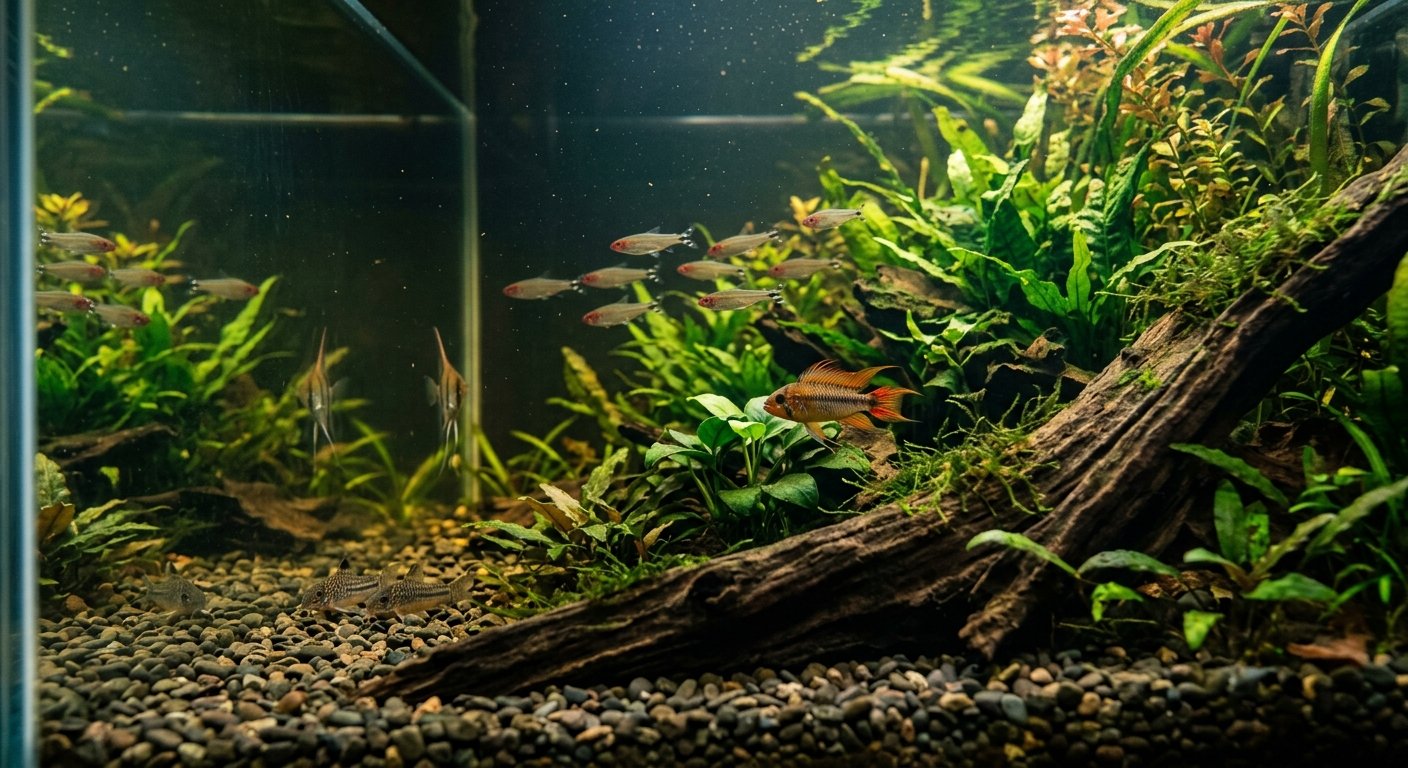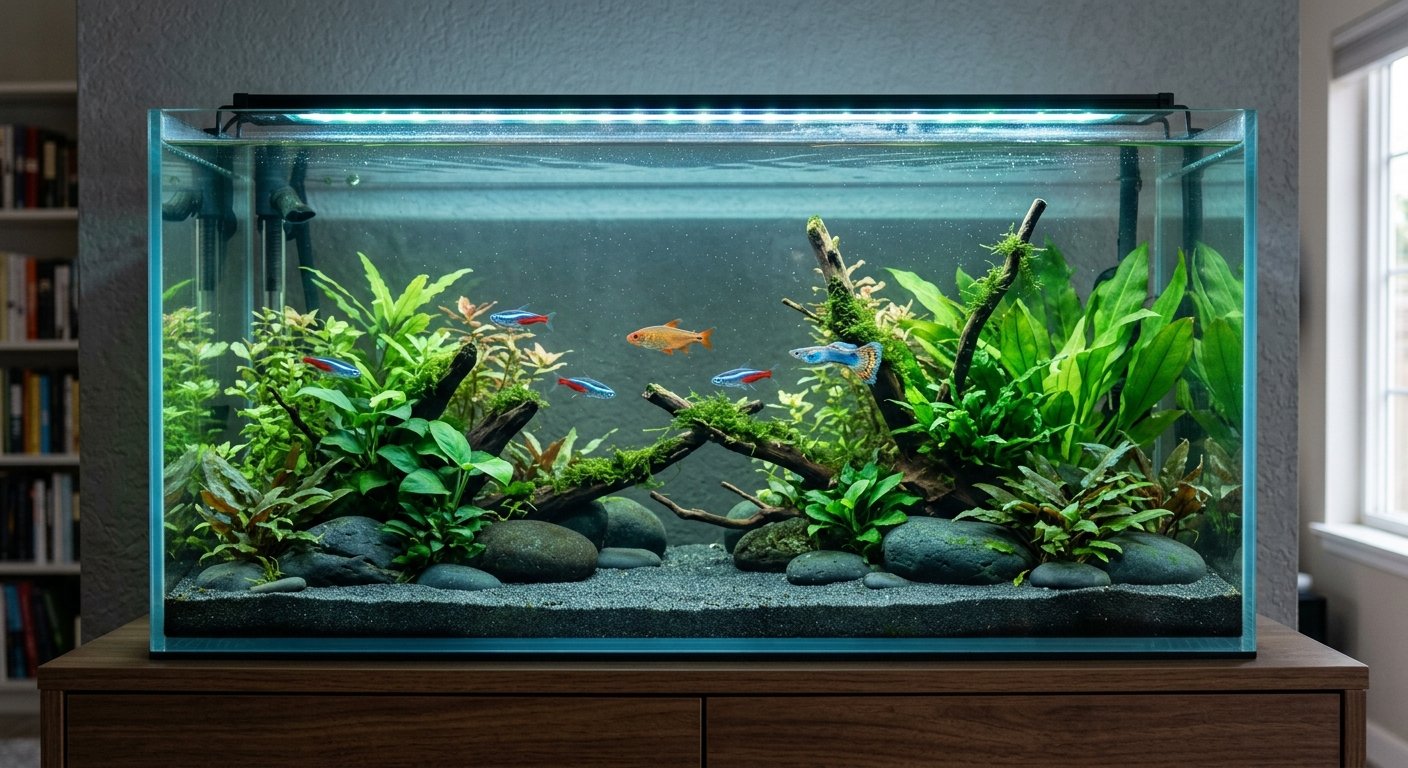
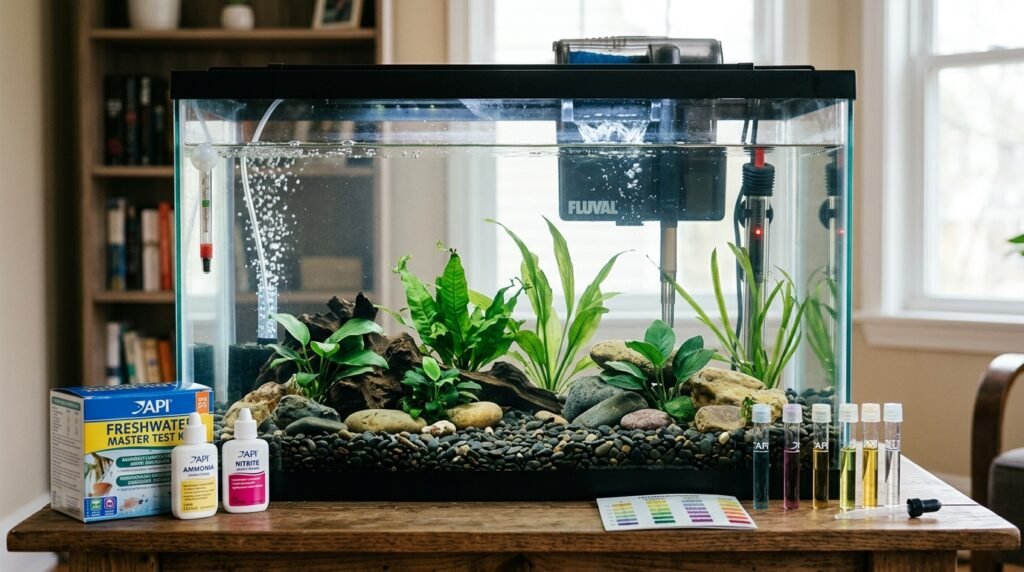
If you just set up a new aquarium, I know exactly what you’re feeling right now: the water’s crystal clear, the filter’s humming along, the decorations look great, and you’re itching to go buy fish. Please don’t yet.
Here’s the thing nobody tells you at the pet store: a brand-new tank is basically a sterile fish tank-shaped bucket. It has none of the invisible bacteria that actually keep fish alive. Adding fish before that bacteria colony builds up is one of the most common, and most heartbreaking, mistakes new fishkeepers make. It’s so common it even has a name: “new tank syndrome,” and it kills a lot of fish that never needed to die.
The good news? Cycling a tank isn’t complicated. It just takes patience. Let’s walk through what’s actually happening in your tank, and exactly how to do this right.
What “cycling” actually means
Every fish that swims in your tank is also, constantly, going to the bathroom in it. That waste, along with any uneaten food, breaks down into ammonia, which is highly toxic to fish even in small amounts.
In a mature, healthy aquarium, you never notice this because colonies of bacteria living mostly in your filter media are quietly converting that ammonia into something less dangerous. This happens in two steps:
- One type of bacteria converts ammonia into nitrite (also toxic to fish)
- A second type of bacteria converts nitrite into nitrate (much less harmful, and removable through water changes)
This two-step process is called the nitrogen cycle, and “cycling a tank” simply means growing enough of both bacteria types, in your filter, before fish depend on them to survive.
Here’s the problem: bacteria don’t move in overnight. They need something to eat (ammonia) and time to multiply. A brand-new tank has neither an established colony nor, usually, any ammonia to feed one. That’s exactly why we cycle it first.
Set the tank up like fish already live there
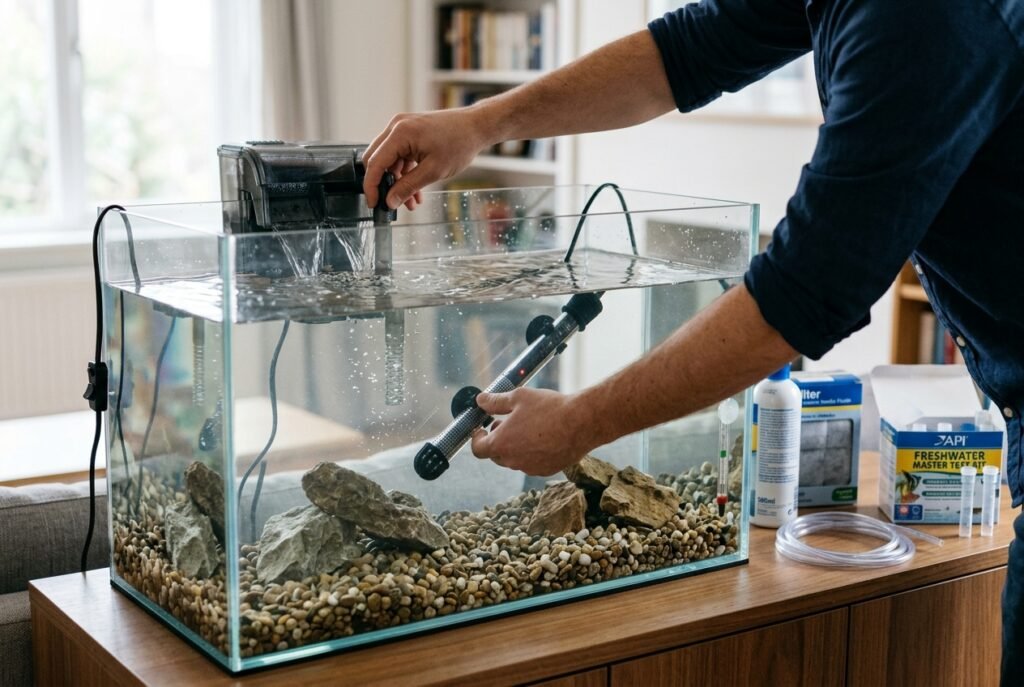
Before you add any ammonia source, get the tank into its “final” state:
- Install your filter, heater, air pump, and any other equipment
- Fill with water that’s been treated with a dechlorinator (untreated tap water contains chlorine or chloramine, which kills the very bacteria you’re trying to grow)
- Rinse new gravel and decorations with plain water. Skip soap entirely; it leaves residue that’s harmful to fish
- Turn the filter on and leave it running continuously. The bacteria you’re growing live in the filter media and need constant oxygenated water flow to survive
You’ll also want a liquid test kit. The API Freshwater Master Test Kit is the standard recommendation in most fishkeeping communities, since it’s far more accurate than test strips. It should measure:
- Ammonia
- Nitrite
- Nitrate
- pH
Keep the tank at the temperature your future fish will need. Stability matters more than hitting an exact number; bacteria don’t love swinging temperatures any more than fish do.
Fishless cycling: the method almost every expert recommends
You do not need fish in the tank to cycle it. In fact, putting fish in an uncycled tank means subjecting them to exactly the ammonia and nitrite spikes cycling exists to prevent. Instead, fishless cycling lets you feed the bacteria yourself with an ammonia source, with no animal ever exposed to the toxic phase.
Two common ammonia sources:
- Pure ammonia products made for cycling, the better option, since dosing is precise and predictable
- Fish food, left to decay, which works but is a much blunter tool. You can’t control exactly how much ammonia it produces or when, and it tends to take longer
If you go with a bottled ammonia source, follow the label dosing exactly. Resist the urge to dump in extra “just in case.” More on why below.
The step-by-step process
1. Start with treated water and running equipment. Dechlorinate the water and confirm your filter and heater are running before you add anything else.
2. Add your ammonia source. Dose according to the product label, or add a small, controlled amount of fish food if that’s your chosen method.
3. Test the water every couple of days and log the results. In the earliest days, you’ll mostly see ammonia, with nothing consuming it yet. This is normal.
4. Watch for the first shift. As the first bacteria strain establishes, ammonia will start dropping and nitrite will start climbing in its place. This is a genuinely exciting moment; it means the cycle is working.
5. Watch for the second shift. Eventually a second bacteria strain takes hold, nitrite starts falling, and nitrate starts appearing and climbing. Once nitrite is consistently dropping to zero within 24 hours of dosing, you’re close.
6. Don’t rush the finish line. This is the step most people get wrong. A biofilter commonly takes around six weeks to fully establish, according to the Merck Veterinary Manual, sometimes longer depending on your tank size, water source, and equipment. Running the filter for two weeks and calling it done is the #1 reason “cycled” tanks still crash once fish move in.
7. Confirm with your test kit before buying a single fish. You want to see, on the same day:
- Ammonia: 0 ppm
- Nitrite: 0 ppm
- Nitrate: detectable (this actually confirms the full cycle happened; if nitrate is at zero too, something’s off)
| Test | What you’ll see mid-cycle | What you want before adding fish |
| Ammonia | Rises, then falls as bacteria establish | 0 ppm |
| Nitrite | Appears once ammonia drops, then falls | 0 ppm |
| Nitrate | Appears as nitrite is processed | Detectable |
| pH | May shift during the process | Stable, appropriate for your species |
Why clear water is lying to you
This trips up more new fishkeepers than anything else: clear water tells you nothing about whether your tank is cycled. Ammonia and nitrite are invisible. A tank can look flawless and still be actively toxic. The only way to know what’s really happening is to test it, not to eyeball it, and not to just count days on a calendar.
Cloudy water, by the way, is a separate issue entirely (usually a bacterial bloom as your microbial community establishes itself) and isn’t a reliable cycling indicator either, in either direction.
What throws a cycle off track
A few things commonly stall or reset a cycle:
- Undechlorinated water used in top-offs or water changes. It kills bacteria along with chlorine
- Rinsing filter media under tap water instead of used tank water. Same problem, and it’s an easy habit to fall into during routine cleaning
- Replacing all your filter media at once. This strips out most of the bacteria you’ve spent weeks growing. Replace media gradually, never all in one go
- Chasing a “perfect” pH with frequent chemical adjustments. This destabilizes the bacteria colony more than an imperfect but steady pH ever would
- Overdosing ammonia thinking it’ll speed things up. It doesn’t. It just risks stalling the bacteria at levels they can’t process, or worse, killing them off entirely with pH crashes from the excess
Adding your first fish
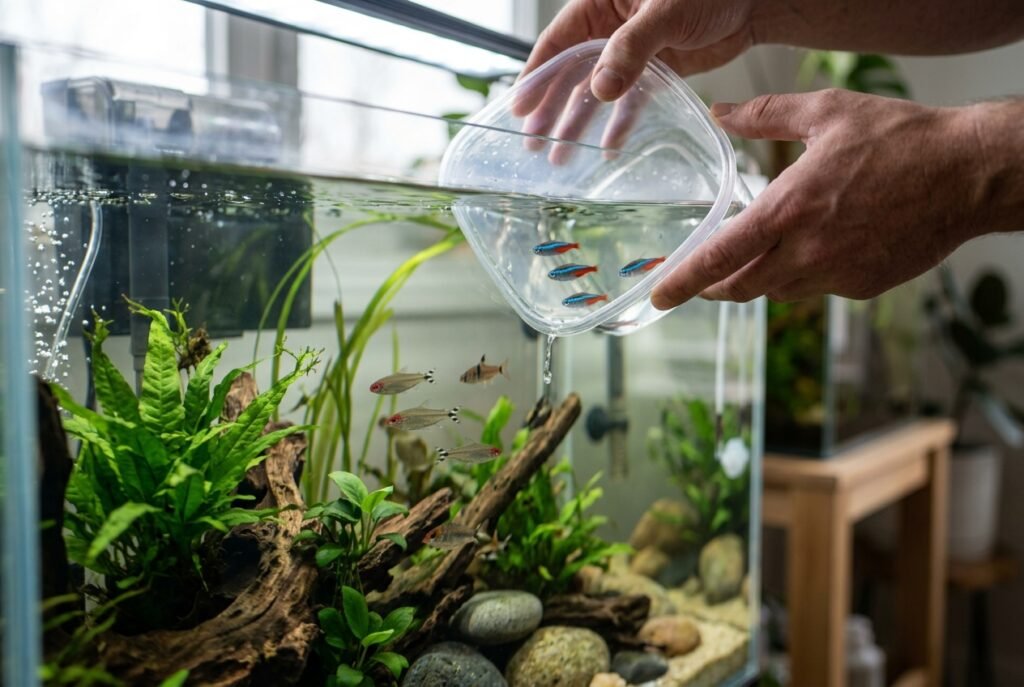
Once ammonia and nitrite both read zero consistently, and temperature/pH suit your species, you’re ready, but go slowly. Your bacteria colony has grown to match the amount of ammonia you were feeding it during cycling, not necessarily a full tank of fish.
- Add fish in small batches, not your entire planned stocking list at once
- Re-test a few days after each addition
- If ammonia or nitrite pops back up, that’s your bacteria colony catching up. Do a partial water change to bring levels down and hold off on more fish until it stabilizes
This “start small, add gradually” approach is sometimes called fish-in cycling when done without a fishless head start, and it works, but it’s riskier since your fish are absorbing whatever spikes happen along the way. If you’ve already fishless-cycled properly, you’re just doing normal, careful stocking from here.
Keeping it cycled long-term
A finished cycle isn’t a finish line. It’s more like turning on a system that now needs upkeep:
- Keep the filter running around the clock
- Don’t overfeed (excess food means excess ammonia load)
- Stick to regular partial water changes to keep nitrate in check
- Replace filter media gradually, never all at once
- If you ever notice odd fish behavior, cloudy water, or a bad smell, test the water before assuming you just need a deep clean. It’s often telling you something more specific
Goldfish in particular produce a heavier bioload than most community fish and deserve extra attention to filtration and stocking density.
Quick answers to common questions
Can I skip fishless cycling and just cycle with fish in the tank? You can, but you’re accepting that your fish will be exposed to some ammonia and nitrite along the way. Fishless cycling exists specifically to avoid that risk.
Ammonia’s at zero. Can I add fish now? Not yet. Nitrite needs to hit zero too. A lot of tanks look “done” at the ammonia stage but are still mid-cycle on nitrite.
Do I need bottled bacteria to cycle a tank? Not strictly. Bacteria will colonize a tank naturally given enough time. Bottled bacterial products can speed the process up in some cases, but they don’t replace testing, and they’re not a shortcut past waiting for confirmation.
It’s been 5 weeks and nitrite still isn’t at zero. What’s wrong? Nothing’s necessarily wrong. Some tanks just take longer, especially larger ones or ones with less oxygen flow. Double-check your filter is running properly and your water source is fully dechlorinated. If readings still look strange, an aquatic vet or experienced local fish store staff can help troubleshoot.
My tank has live plants. Do I still need to cycle it? Yes. Plants absorb some nitrogen compounds, which helps, but they don’t replace the bacterial colony a filter needs. Test before stocking regardless of how green the tank looks.
Once your tank is up and running, keeping the filter clean without wrecking your bacteria colony is its own small art. See our guide on how to clean a fish tank filter the right way.