


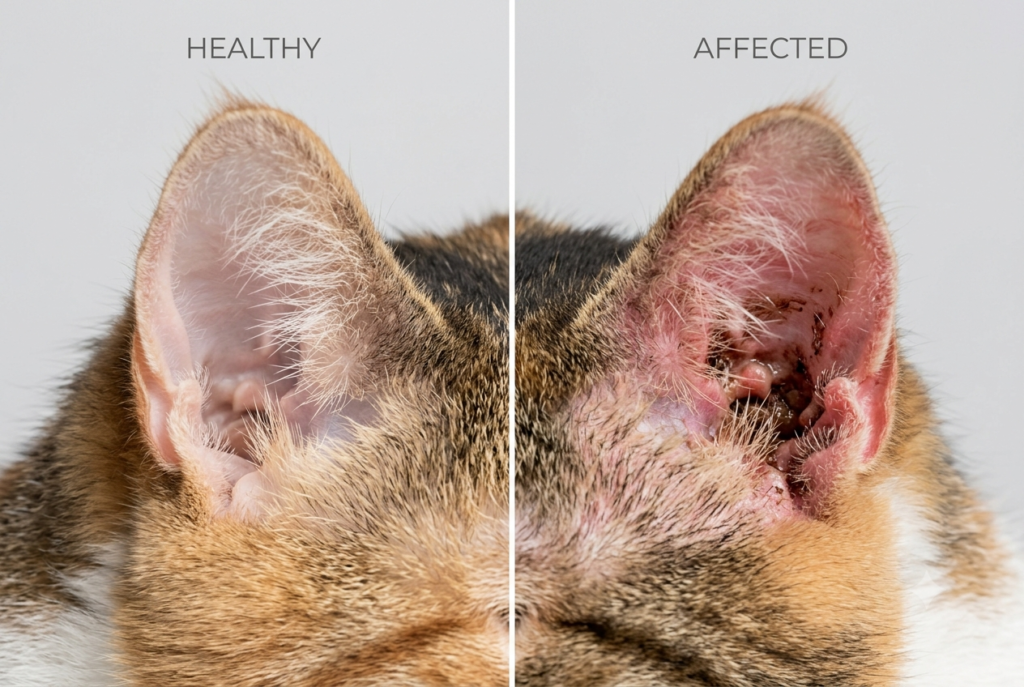
The quickest way to tell ear mites from a yeast infection in cats is the discharge. Ear mites produce dry, dark, crumbly debris that looks like coffee grounds, while a yeast infection produces brown, greasy, waxy discharge with a musty smell. Both make a cat scratch and shake its head, so the debris is often the clearest clue. This guide sets the two side by side so you know what you are looking at and what to do next.
Quick answer: Dry, dark, coffee-ground debris means ear mites, a contagious parasite common in kittens and outdoor cats. Brown, greasy, musty-smelling wax means a yeast infection, an overgrowth that is not contagious and usually has an allergy behind it. They look similar and both cause scratching, but they need completely different treatment, so a vet swab is the only way to be certain.
Ear mites vs yeast infection at a glance
The two conditions share symptoms on the surface, which is exactly why they get confused. The differences are in the detail.
| Feature | Ear mites | Yeast infection |
| Cause | Parasite (Otodectes cynotis) | Overgrowth of yeast (Malassezia) |
| Discharge | Dry, dark, crumbly, coffee-ground look | Brown, greasy, waxy |
| Smell | Mild, builds with irritation | Distinctly musty, sweet, or yeasty |
| Contagious? | Yes, spreads easily between pets | No, develops within the individual cat |
| Most affected | Kittens, outdoor and multi-cat homes | Adults, allergy-prone cats |
| Usual trigger | Contact with an infected animal | Allergy or trapped moisture |
| Onset | Often sudden and intensely itchy | Often gradual, sometimes recurring |
For the full detail on each, see signs of ear mites in cats and cat ear yeast infection.
The symptoms they share
Because both irritate the ear canal, several signs overlap and cannot be used to tell them apart on their own.
Both conditions cause scratching at the ears, head shaking or tilting, redness inside the ear flap, and general discomfort. A cat with either problem may paw at its ear or seem unsettled. If you only look at behaviour, the two are almost impossible to separate. That is why the discharge, the smell, and whether other pets are affected matter so much.
The differences that actually tell them apart
Three things reliably point you toward one or the other.
- The discharge. This is the single most useful clue. Mite debris is dry, dark, and crumbly, like coffee grounds. Yeast discharge is brown, greasy, and waxy. The texture is often easier to judge than the colour. Both are covered in black and brown discharge in a cat’s ears.
- The smell. A yeast infection usually carries a distinct musty or sweet odour. Mites produce less smell early on, though a strong bad smell can appear if a secondary infection develops.
- Whether other pets are affected. Mites are highly contagious. If more than one pet in the home is suddenly scratching, mites are far more likely. Yeast infections do not spread this way, so a single affected cat with no others itching leans toward yeast.
Why the difference matters for treatment
Getting this right is not academic. The treatments do not overlap.
Ear mites need an antiparasitic medication to kill the parasite, plus treating every pet in the home so they do not simply reinfect each other. A yeast infection needs an antifungal medication, and usually attention to the allergy or moisture problem underneath it. An antifungal does nothing to mites, and an antiparasitic does nothing to yeast. Treat the wrong one and you lose days or weeks while the real problem gets worse, and the constant scratching can add a secondary infection on top.
This is also why home guessing is risky. The two most reliable clues, the discharge and the smell, still overlap enough that even experienced owners get it wrong. A vet settles it in minutes.
How a vet tells them apart
A vet does not rely on appearance alone. They take a swab of the debris and look at it under a microscope. Mites are visible moving in the sample, while yeast shows up as distinct cells. This single test removes the guesswork completely and confirms whether you are dealing with one, the other, or occasionally both at once. They will also check the ear canal and eardrum with an otoscope, since that affects which medications are safe to use.
What to do if you are not sure
If your cat is scratching and you cannot tell which one it is, do not start treatment blindly.
Avoid reaching for a leftover product or an over-the-counter remedy on a guess, since using the wrong one delays proper treatment. You can gently note what you see, the colour and texture of any discharge, whether there is a smell, and whether other pets are affected, as this helps your vet. Then book a vet visit. A quick swab gives you a definite answer and the correct treatment, which is far faster overall than trying one product, waiting, and then trying another.
When should you see a vet?
See a vet whenever your cat has ongoing ear scratching, head shaking, or visible discharge, regardless of which condition you suspect, since both need proper treatment. Go sooner if the ear is painful, swollen, or bleeding, or if a head tilt or loss of balance appears, as that points to a deeper problem. And if more than one pet is scratching, book in promptly, because contagious mites spread through a household quickly.
Frequently asked questions
Can a cat have both ear mites and a yeast infection at once?
Yes. The intense scratching from mites can damage the ear and allow a secondary yeast or bacterial infection to develop on top. This is one reason a vet diagnosis matters, since both may need treating together.
How can I tell mites from yeast at home?
The best clues are the discharge and smell. Dry, dark, coffee-ground debris suggests mites, while greasy brown wax with a musty smell suggests yeast. Neither is fully reliable on its own, so a vet swab is the only certain way.
Are ear mites or yeast infections more common in cats?
Ear mites are more common in kittens and outdoor cats, while yeast infections are more common in adult cats and those with allergies. Both are frequent causes of ear trouble.
Will the same medication treat both?
No. Mites need an antiparasitic and yeast needs an antifungal. Neither medication works on the other condition, which is why an accurate diagnosis is essential before treating.
Is one more serious than the other?
Both are treatable and neither is usually dangerous when caught early. Left untreated, either can lead to a deeper, more painful infection, so early diagnosis matters more than which one it is.