 Skip to content





How often to clean a hamster cage depends on its size and how deep the bedding is. Most hamsters need a daily spot clean, plus a full clean about once a week in a small cage or every few weeks in a large, deep-bedded enclosure.
Search this question and you’ll find two camps. One says clean the whole cage every week. The other says deep clean once or twice a month and leave the rest alone. Both camps have vets and welfare charities behind them, and both are right, for different cages.
What decides it is the size of the enclosure, how deep the bedding is, and whether your hamster uses one corner as a toilet. This guide gives you a schedule for each situation, the signs that a clean is overdue, and a way to do it without upsetting your hamster.
Why the advice contradicts itself
Older advice, including some veterinary clinic handouts, says to spot clean daily and change all the bedding weekly. That works for a small cage with a thin layer of bedding, where urine soaks through fast.
Welfare groups now push for much bigger homes. The PDSA suggests at least 100 x 50 cm of floor space, a figure from the Veterinary Association for Animal Welfare, with about 25 cm of bedding for burrowing. It says small cages generally need a full clean about once a week, while very large setups may only need one every few weeks. The RSPCA says a deep clean once or twice a month is usually enough, depending on cage size and whether your hamster uses a set toilet area.
A vet-reviewed guide on The Vet Desk, reviewed by Dr. Maja Platisa, takes the weekly route: daily spot cleaning plus a weekly deep clean. So the honest answer isn’t one number. The bigger the enclosure and the deeper the bedding, the less often you need to strip it. Daily spot cleaning does most of the work.
How often to clean a hamster cage, by setup
| Your setup | Spot clean | Full clean |
|---|---|---|
| Small cage or shallow bedding | Daily | About once a week |
| Large enclosure (100 x 50 cm or bigger) with deep bedding | Daily, or at least every few days | Every 2 to 4 weeks |
| Hamster has no fixed toilet corner, or you keep more than one hamster | Daily | Sooner than the rows above. The Vet Desk suggests twice a week for multiple hamsters. |
These ranges come from the PDSA and RSPCA guidance. Treat them as a starting point and let your nose and the bedding tell you when to adjust.
What spot cleaning involves
Each day, take out wet or soiled bedding, wash the food and water bowls, and clear away leftover food from the day before. The PDSA recommends doing this in the evening, when your hamster is awake, and the RSPCA also advises cleaning when they’re awake. Hamsters are nocturnal, so a daytime clean means waking a sleeping animal.
If daily isn’t realistic, the RSPCA says every few days is still advisable. A hamster that always goes in one corner makes this quick, because you only need to scoop that spot.
If your hamster has a sand bath, take the sand out once they’ve finished. PetMD notes that leaving it in the cage can irritate the airways over time.
Signs the cage needs cleaning sooner
Don’t wait for the calendar if you notice any of these:
- A sharp ammonia smell when you lean close to the cage
- Bedding that looks more soiled than usual or feels damp. The RSPCA says bedding should stay dry.
- Your hamster has stopped using one toilet spot and is going all over the cage
- A tube system. PetMD points out that the joints in connecting tubes can trap bacteria and become a source of ammonia.
- White, crusty urine stains on the cage floor or accessories
- Stored food that has piled up and started to smell
The smell matters because ammonia irritates the airways. PetMD lists ammonia buildup from poor hygiene, poor ventilation, and dusty or scented bedding among the causes of hamster sneezing.
An occasional sneeze is usually nothing. See an exotic vet if sneezing becomes frequent or comes with eye or nose discharge, laboured or wet-sounding breathing, lethargy, weight loss, or a drop in appetite.
How to deep clean without stressing your hamster
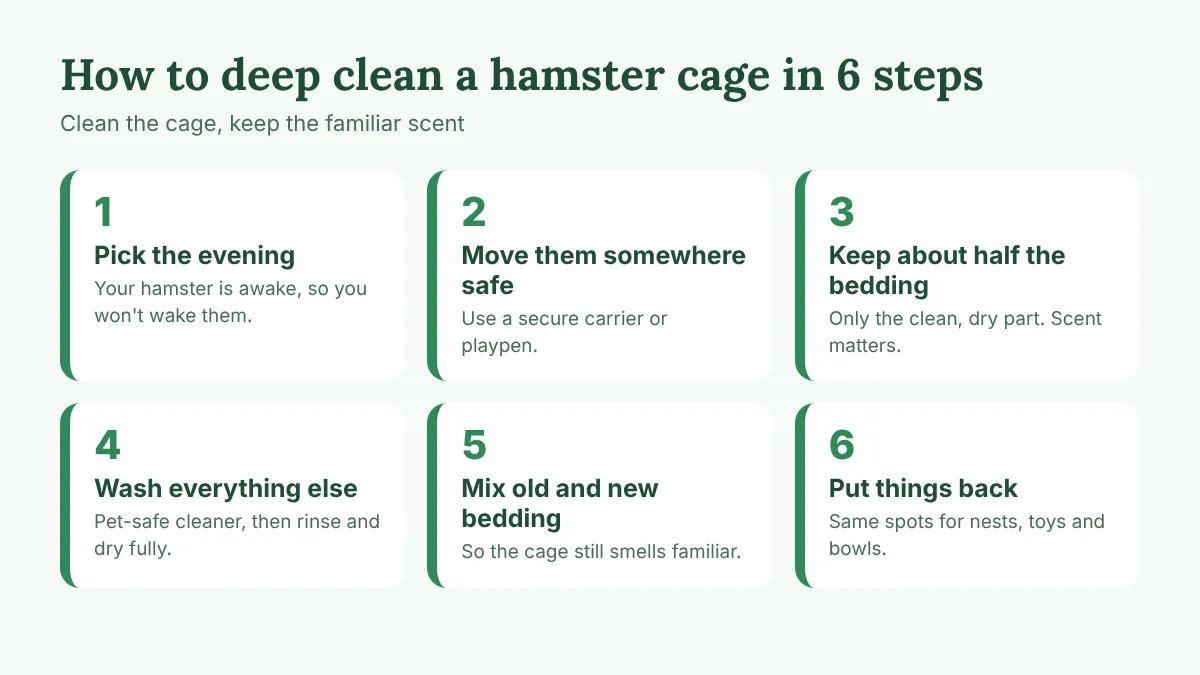
- Choose the evening. Your hamster is awake and you won’t interrupt their sleep.
- Move them somewhere safe. A secure carrier or playpen works while you clean.
- Take out the bedding, but keep about half. The PDSA says to keep roughly half of it, as long as it’s clean and dry. Smell is very important to hamsters, and the RSPCA recommends putting a little old, unsoiled bedding and nesting material back.
- Wash everything else. Clean the base and accessories with a pet-safe cleaner, then rinse and dry them fully. The RSPCA also says to clean or replace any items soiled with droppings.
- Refill with the old and new mixed together. Blend fresh bedding into what you kept so the cage still smells familiar.
- Put things back where they were. The PDSA says hamsters prefer a consistent layout, so return nests, toys, and bowls to their old spots.
Don’t forget the accessories
A deep clean covers more than the bedding. The Vet Desk says to take out the hideouts, bowls, water bottle, toys, and wheel, then wash, rinse, and dry the toys, tunnels, wheel, and dishes. Fabric toys are hard to get truly clean, so it says they may need replacing.
Put some of your hamster’s food back after the clean, and clear out any big stash that has started to smell. The Vet Desk also suggests wearing cleaning gloves or using a scoop so you don’t touch droppings and urine, then washing your hands well afterward. Pat the cage dry before you add bedding, because leftover damp can lead to mold.
What to clean with, and what to leave out
The PDSA’s advice is simply to use a pet-safe cleaner, then rinse and dry. The Vet Desk guide recommends mild dish or hand soap in warm water, or a cage-cleaning solution, and says to avoid scented soaps and strong chemicals. Whatever you use, rinse well and let everything dry before your hamster goes back in.
Bleach is the one that divides opinion. PetMD’s hamster care guide says a 1 part bleach to 10 parts water solution can sanitize a cage, but only if it is rinsed thoroughly and dried completely before the hamster returns. For a routine clean, soap and warm water is enough, so in our view bleach isn’t worth the risk to a small animal’s airways.
Bedding matters as much as the cleaner. The PDSA lists paper-based bedding, aspen, spruce, and hemp as safe options, and warns against pine and cedar shavings because they’re dusty, along with scented bedding and fluffy materials like cotton wool. PetMD also names dusty or scented bedding as a cause of sneezing.
Mistakes that backfire
- Stripping a large, deep-bedded enclosure every week. The RSPCA and PDSA both say a big setup needs a full clean far less often. Constant clean-outs remove the scent your hamster relies on.
- Throwing out all the old bedding. You remove the scent that makes the cage feel like home.
- Cleaning in the middle of the day. This wakes a sleeping animal.
- Rearranging everything after a deep clean. A familiar layout helps your hamster settle.
- Skipping the rinse or the drying time. Both the PDSA and The Vet Desk say to rinse and dry everything before it goes back in.
If you keep more than one hamster
More hamsters means more mess, so clean at the shorter end of the ranges above. The RSPCA notes that odors from soiled items may trigger fighting in groups, which is another reason not to let things slide. Our guide to whether a hamster needs a friend explains why Syrian and Chinese hamsters should live alone and why keeping dwarf hamsters together is a judgment call.
Sources
- The ideal home for your hamster, PDSA
- Creating the right home for your hamster, RSPCA
- Why Is My Hamster Sneezing?, PetMD
- How to Care for Your Hamster, PetMD
- Hamster Cages, PetMD
- How to Clean a Hamster Cage: 6 Vet-Reviewed Steps, The Vet Desk (reviewed by Dr. Maja Platisa, DVM MRCVS)
This article is general information, not veterinary advice. If your hamster seems unwell, see an exotic vet.


