Skip to content





Yes, most dogs can eat peanut butter. The problem is the jar, not the peanuts. Some brands sweeten their peanut butter with xylitol, a sugar substitute that’s harmless to people and dangerous to dogs. So the better question is whether the peanut butter in your cupboard is safe for your dog.
If the ingredient list says peanuts, and maybe a little salt, a small spoonful makes a fine treat. If it lists xylitol or anything that sounds like it, your dog shouldn’t have any. Below you’ll find how to read the label, how much is reasonable, which dogs should skip it, and what to do if your dog already got into the wrong jar.
How to check peanut butter for xylitol
Dogs handle xylitol differently from people. In a dog it’s absorbed quickly and sets off a rush of insulin, which can crash blood sugar. The FDA says low blood sugar can start within 10 to 60 minutes of eating it, and some serious effects may not show up for 12 to 24 hours. The agency also lists some peanut and nut butters among the products that can contain it.
Turn the jar around and read the ingredient list. The front of the label tells you very little. Look for:
- Xylitol, or any ingredient with “xyl” in the name. This tip comes from the ASPCA’s poison control team, as passed along by NC State’s veterinary college.
- Birch sugar, birch bark extract, wood sugar, or xylite. These are other names for the same sweetener.
- “Sugar alcohol” with no detail. It may or may not be xylitol, so treat it as a no. MedVet notes that some companies list sugar alcohols, which can include xylitol.
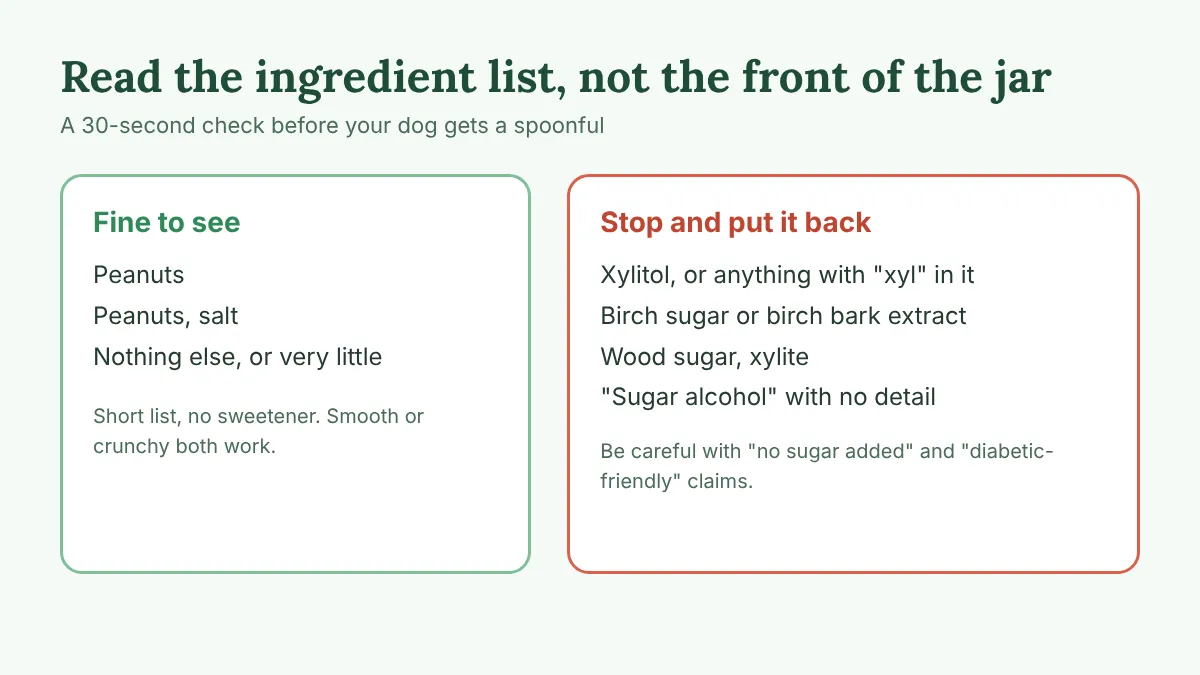
Claims on the front of the jar deserve a second look, too. The American Kennel Club points to phrases like “no sugar added,” “reduced sugar,” and “diabetic-friendly” as possible signs that a sweetener is hiding in the recipe.
PetMD and NC State both name a few brands that have sold peanut butter with xylitol, including Go Nuts Co., Krush Nutrition, Nuts ‘n More, and P28 Foods. PetMD says mainstream jars like Jif and Skippy generally don’t use it. Recipes change, though, and a brand that was fine last year might not be this year. Read the label every time you buy a jar, even if it’s the one you always get.
The same habit pays off with canned pumpkin, where plain puree and pie mix sit side by side on the shelf. Our pumpkin guide for dogs explains the difference.
What kind of peanut butter is best for dogs
The best jar has the shortest ingredient list: peanuts, and maybe salt. Skip anything with added sugar, flavorings, or sweeteners. Smooth and crunchy are both fine as long as the label passes the check above.
Dog-specific peanut butters exist, and they’re a reasonable choice if you’d rather not think about it. They carry the same calories, so the portion advice below applies either way. Unsalted is a good pick when you can find it. If your dog has kidney disease or diabetes, ask your vet before offering any.
How much peanut butter can a dog have?
Peanut butter is dense. PetMD puts it at roughly 180 to 200 calories per two tablespoons, mostly from fat. That works out to about 30 calories in a teaspoon, which doesn’t sound like much until you compare it with what a small dog eats in a whole day.
The usual rule is that treats should stay under 10 percent of daily calories, the same rule we lean on in our rice guide. Vet-reviewed sources land on small amounts. PetMD suggests a ceiling of half a teaspoon for a small dog and one teaspoon for a medium or large dog, up to twice a day. Some other sites allow more, up to a tablespoon for big dogs. Since the advice varies, it’s easier to work from your own dog’s calorie budget.
| Dog size | Rough daily calories | Treat budget (10%) | Peanut butter that uses the whole budget |
|---|---|---|---|
| 10 lb | about 300 | about 30 | about 1 teaspoon |
| 20 lb | 325 to 400 | 33 to 40 | 1 to 1¼ teaspoons |
| 50 lb | about 1,000 | about 100 | about 1 tablespoon |
These are estimates for typical adult dogs. Calorie needs shift with age, activity, and whether your dog is neutered, so ask your vet for a daily target. The budget also covers every treat combined. If your dog already had a biscuit or a dental chew today, the peanut butter comes out of the same allowance.
For a larger dog, PetMD’s limit of a teaspoon twice a day sits below what the table would allow, and that’s a sensible place to stay. Peanut butter works best as a reward, not a daily topping. Sources differ on whether a little every day is fine, so “occasionally” is the safer default.
Which dogs should skip it or ask a vet first
Peanut butter is about half fat by weight, which makes it the wrong treat for some dogs.
- Dogs with a history of pancreatitis, or on a low-fat diet. The Merck Veterinary Manual says mild pancreatitis cases are usually moved to a low-fat diet and low-fat treats. PetMD says these dogs may need to avoid peanut butter unless their vet approves it.
- Overweight dogs. The calories add up fast, and your vet can suggest a lighter reward.
- Dogs with diabetes or kidney disease. Petco advises checking with a vet first.
- Dogs who react to peanuts. Watch for itchy or red skin, heavy scratching or licking, hives, vomiting, or diarrhea after a serving. Stop feeding it and call your vet. Swelling of the face or throat is an emergency.
Even a healthy dog can get soft stools or bloating from too much, which is another reason to keep portions small.
What to do if your dog ate peanut butter with xylitol
Treat it as an emergency, even if your dog looks normal. Signs may not show right away, and treatment works best when it starts early.
- Call your vet or the nearest emergency animal hospital right away. The FDA says to get your dog to a vet immediately if xylitol may have been eaten.
- Bring the jar. The label helps the vet judge how much xylitol your dog may have eaten.
- If you can’t reach your vet, call Pet Poison Helpline at (855) 764-7661. The line is listed as open 24 hours a day.
- Don’t try to make your dog vomit or treat it at home unless a vet tells you to. NC State’s veterinary college warns that the wrong home treatment can make things worse.

Watch for vomiting, weakness, staggering, tremors, collapse, and seizures. At the clinic, vets usually monitor blood sugar and give IV fluids and dextrose. There’s no antidote for xylitol poisoning, according to Small Door Veterinary, but dogs treated quickly can make a full recovery.
Using peanut butter without overdoing it
PetMD lists a few good uses: training rewards, stuffing a food toy like a KONG, spreading a thin layer on a lick mat, and distracting a dog during baths or nail trims. A thin smear goes a long way. Dogs find a small amount about as exciting as a big one.
Hiding pills is where the xylitol risk sneaks in. The FDA specifically says to check nut butters before using them as pill covers, and NC State points out that owners often hide pills in peanut butter, so a dog can end up eating xylitol along with its medication. A small dab is enough, and it still counts toward the day’s calories.
If you want another high-value treat that doesn’t depend on a label, plain cooked eggs are one option. We cover how to serve them in our guide to feeding eggs to dogs.
Crunchy, puppies, and peanut butter and jelly
Crunchy is fine. The same label rules apply, and PetMD says it’s fine as long as the ingredients are simple and free of artificial sweeteners.
Puppies can have peanut butter in small amounts, according to PetMD, and it’s best introduced slowly. A puppy’s daily calorie needs are small, so a tiny lick goes a long way. Ask your vet before making it a habit.
Peanut butter and jelly isn’t a good idea. PetMD notes that the sugar in jelly can upset a dog’s stomach. Plain peanut butter is the better choice.
Sources
- Paws Off Xylitol; It’s Dangerous for Dogs, U.S. Food and Drug Administration
- Can Dogs Eat Peanut Butter?, PetMD, reviewed by a veterinarian
- Xylitol Toxicity in Dogs: The Peanut Butter Danger, NC State College of Veterinary Medicine
- Dangers of Xylitol, American Kennel Club
- Xylitol Poisoning in Dogs, MedVet
- Symptoms of Xylitol Poisoning in Dogs, Pet Poison Helpline
- Xylitol Poisoning in Dogs, Small Door Veterinary
- Pancreatitis and Other Disorders of the Pancreas in Dogs, Merck Veterinary Manual
- Can Dogs Eat Peanut Butter?, Petco
- Daily calorie estimates: Petsbest and 1-800-PetMeds
This article is general information, not veterinary advice. If your dog has a health condition or you’re unsure whether a food is safe, ask your vet.