
Quick answer: the clearest signs are head shaking, scratching at the ear, a noticeable odor, and some kind of discharge, dark, yellow, or waxy. Catch these early and treatment is quick. Wait too long and it gets a lot more uncomfortable for your dog, and more expensive for you.
Dogs can’t tell you their ear hurts, so you end up playing detective a bit. The good news is ear infections aren’t subtle once you know what you’re looking for. Most dogs give you several signs at once, not just one, which actually makes it easier to catch than you’d think.
Head Shaking
This is usually the first thing people notice. Not the occasional shake after a nap, more like repeated, almost frustrated shaking, sometimes with the head tilted slightly to one side. Dogs do this trying to relieve pressure or discomfort in the canal. If it’s happening several times an hour, or your dog seems to be doing it specifically after you touch or get near their ear, that’s a pretty strong signal.
Scratching
Similar idea, but with a paw instead of a shake. Some dogs scratch gently, others go at it hard enough to scratch themselves raw around the ear or on the side of the face. If you notice hair loss or scabbing near the ear from scratching, the infection’s probably been going on for a bit already.
The Smell
This one’s hard to miss once it’s there. A musty, almost yeasty smell, sometimes described as similar to old cheese or damp socks. Get close to the ear and take a whiff, healthy ears shouldn’t have much of a smell at all. If yours does, and it’s unpleasant, that’s often yeast at work, though bacterial infections have their own distinct sharper odor too.
Discharge
Take a look inside the ear, gently pull back the flap if your dog will let you. Healthy ear wax is usually a light tan color, not much of it. Infected ears show more, and it’s often a different color entirely, dark brown or black usually points to yeast, while yellow or greenish discharge, especially with a bloody tint, tends to mean bacteria. Either way, if there’s noticeably more discharge than usual or it’s an unusual color, that’s a sign.
Redness and Swelling
Take a look inside the canal itself. An infected ear usually looks angrier than the skin around it, redder, and sometimes you’ll see actual swelling in there. Let it go on long enough and the swelling can get bad enough to narrow the canal opening, which just makes everything harder down the line, cleaning, treatment, all of it.
Pain When Touched
Gently touch around the base of the ear. A dog with an infection will often flinch, pull away, or even yelp, something they wouldn’t normally do. Some dogs get head-shy about this specific area even when you’re just trying to pet them, which is worth paying attention to.
Behavior Changes
Beyond the obvious physical signs, watch for anything that feels off. Less interest in play, more irritability, avoiding being touched near the head, or even just seeming a bit withdrawn. Chronic ear pain wears on dogs the same way any ongoing discomfort would, and it shows up in mood before you might notice anything physical.
Rubbing Against Furniture or the Floor
If your dog’s dragging the side of their head along the carpet, couch, or your leg, they’re trying to scratch an itch they can’t quite reach with a paw. This is a pretty reliable sign something’s bothering them in that ear specifically.
Loss of Balance or Odd Eye Movements
This one’s more serious and means the infection has likely progressed past the outer ear. If your dog seems unsteady, is tilting their head persistently rather than just occasionally, or you notice their eyes flicking back and forth in a way that looks unusual, get to a vet quickly. This points to the infection reaching the inner ear, which affects balance.
A Simple Ear Check You Can Do at Home
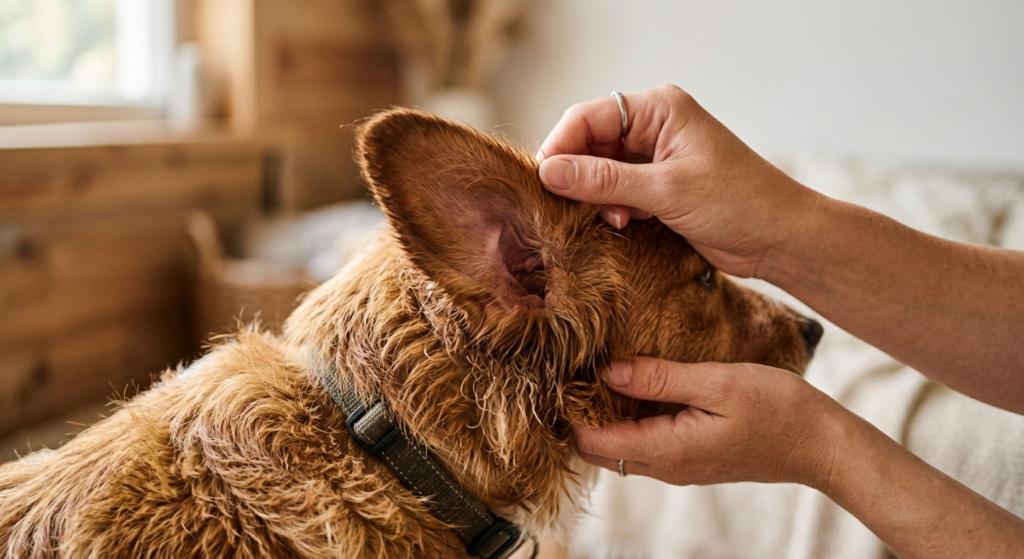
Takes about a minute. Gently lift the ear flap and look inside, checking for redness, discharge, or swelling. Give it a light sniff. Then run your finger softly around the base of the ear and watch your dog’s reaction, flinching or pulling away is a sign something’s tender in there. Do this weekly if your dog’s breed is prone to ear issues, floppy-eared or heavy-coated breeds especially, and you’ll usually catch problems while they’re still mild.
When One Symptom Isn’t Enough to Worry, and When It Is
An occasional head shake or a bit of scratching here and there isn’t automatically an infection, dogs do that normally sometimes. What matters is the combination and the persistence. Several of these signs showing up together, especially smell plus discharge plus scratching, is a much stronger indicator than any single symptom on its own. And once you spot swelling, pain, or balance issues, that’s no longer a “wait and see” situation.
If you’re seeing enough signs to be fairly sure this is an infection, our guide on treating dog ear infections walks through what happens next, from vet diagnosis through recovery.
Bottom Line
Most ear infections announce themselves clearly if you know what to check for, head shaking, scratching, smell, and discharge being the big four. Catching these early usually means a quick, straightforward treatment. Ignoring them for weeks usually means a longer, more uncomfortable recovery, and a bigger vet bill. A quick weekly ear check takes almost no time and catches most problems before they get bad.