Most pet budgies live somewhere between 7 and 15 years. That’s a wide range, and there’s a reason for it: genetics set the ceiling, but everything else, including diet, housing, exercise, vet care, and plain bad luck, decides whether a bird gets anywhere close to it.
If you already own a budgie, or you’re about to bring one home, the honest answer to “how long will it live” is: longer than most first-time owners expect, and it depends more on you than you might think.
The short version
Most pet budgies live somewhere between 7 and 15 years. A healthy budgie in captivity typically lives 7–15 years. PetMD puts the average closer to 10–12 years with good care. Wild budgerigars, by contrast, usually live only 4–6 years, since predators, food scarcity, and weather take a toll that a home environment simply removes.
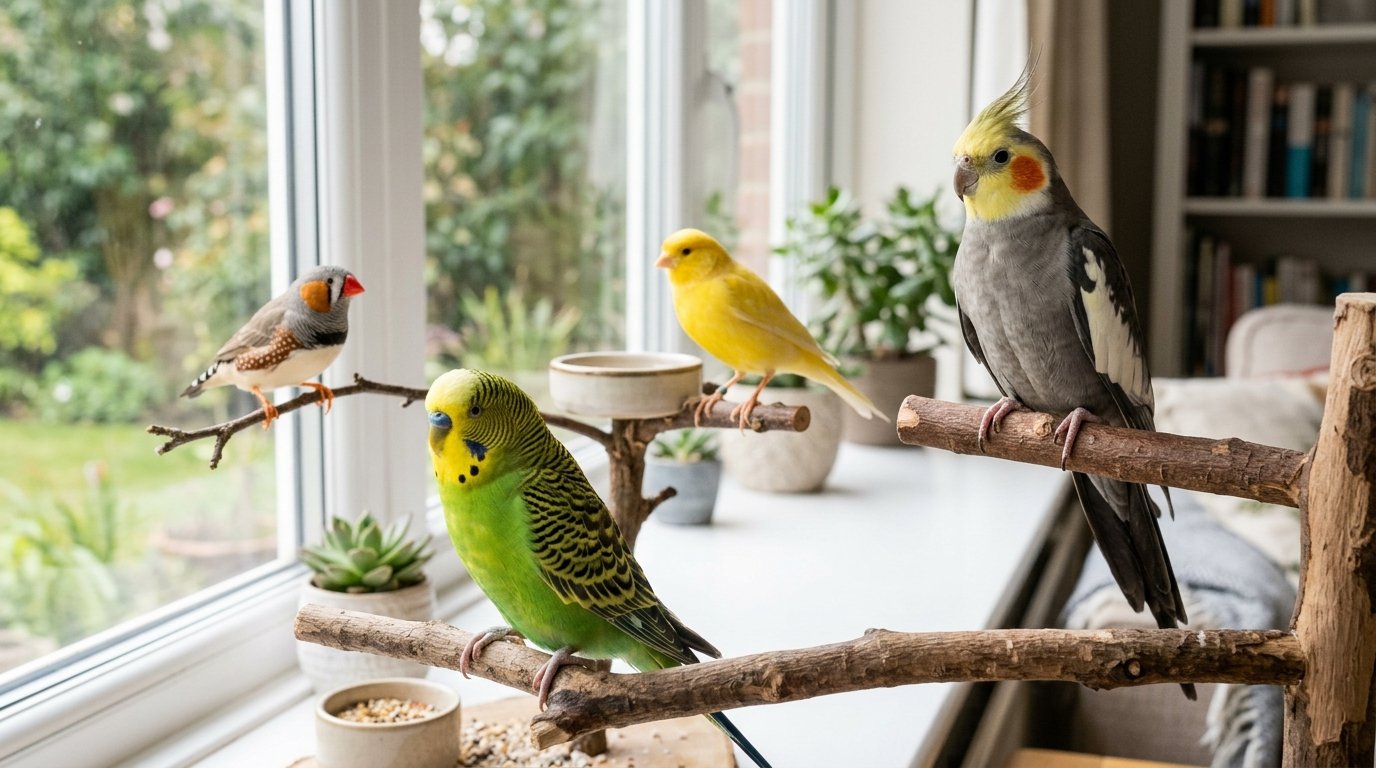
Quick note on terminology: “parakeet” technically covers a whole family of small parrots, but in the US, if someone’s selling you a “parakeet” at a pet store, it’s almost always a budgerigar. If you’re new to the species, What Is a Budgie? A Complete Guide to This Popular Pet Bird covers its appearance, behavior, and origins in more depth. That’s the bird this guide is about.
Why captivity doesn’t automatically mean a longer life
It’s tempting to assume “indoors and fed = safe.” That’s only half true. Captive budgies dodge the risks wild birds face, but they pick up a different set of risks that don’t exist in the wild at all: obesity from a seed-only diet, toxic fumes from a nonstick pan, a ceiling fan left on during out-of-cage time. None of that kills a wild budgie, because a wild budgie never encounters it.
So captivity raises the ceiling on lifespan. It doesn’t guarantee the bird gets there.
What actually determines how long your budgie lives
Diet — probably the single biggest lever you control
Seed mixes are the default at most pet stores, and they’re the most common mistake new owners make. Left to graze on a seed mix, budgies pick out the fatty seeds they like and ignore the rest, so even a “balanced” bag becomes an unbalanced diet in practice. Avian vets generally recommend a base of formulated pellets, supplemented with appropriate fresh foods, rather than seed as the main food source.
One caution: don’t switch a bird’s diet overnight. Budgies can be stubborn about unfamiliar food, and a bird that refuses to eat can lose weight fast. Talk to an avian vet about how to transition gradually.
Exercise and cage time
Budgies need to move, climb, fly short distances, foraging, exploring. A cage is the baseline, not the whole solution. Supervised time outside the cage matters, but only in a room that’s been bird-proofed first: windows covered or closed, fans off, cords out of reach, other pets elsewhere.
Watching activity level also doubles as a health check. A budgie packing on weight without moving much is a warning sign. So is a budgie that’s suddenly lost weight that’s often an earlier and more reliable signal of illness than obvious “sick” behavior.
Housing
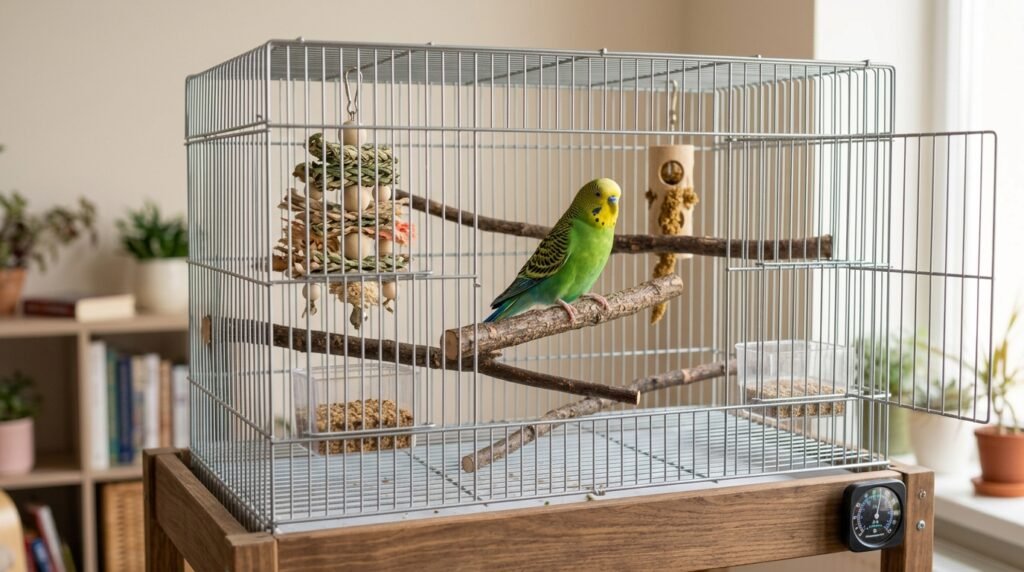
The minimum recommendation is an 18×18 inch cage for a single budgie, treat that as a floor, not a target. Bigger is better, and bar spacing matters as much as square footage.
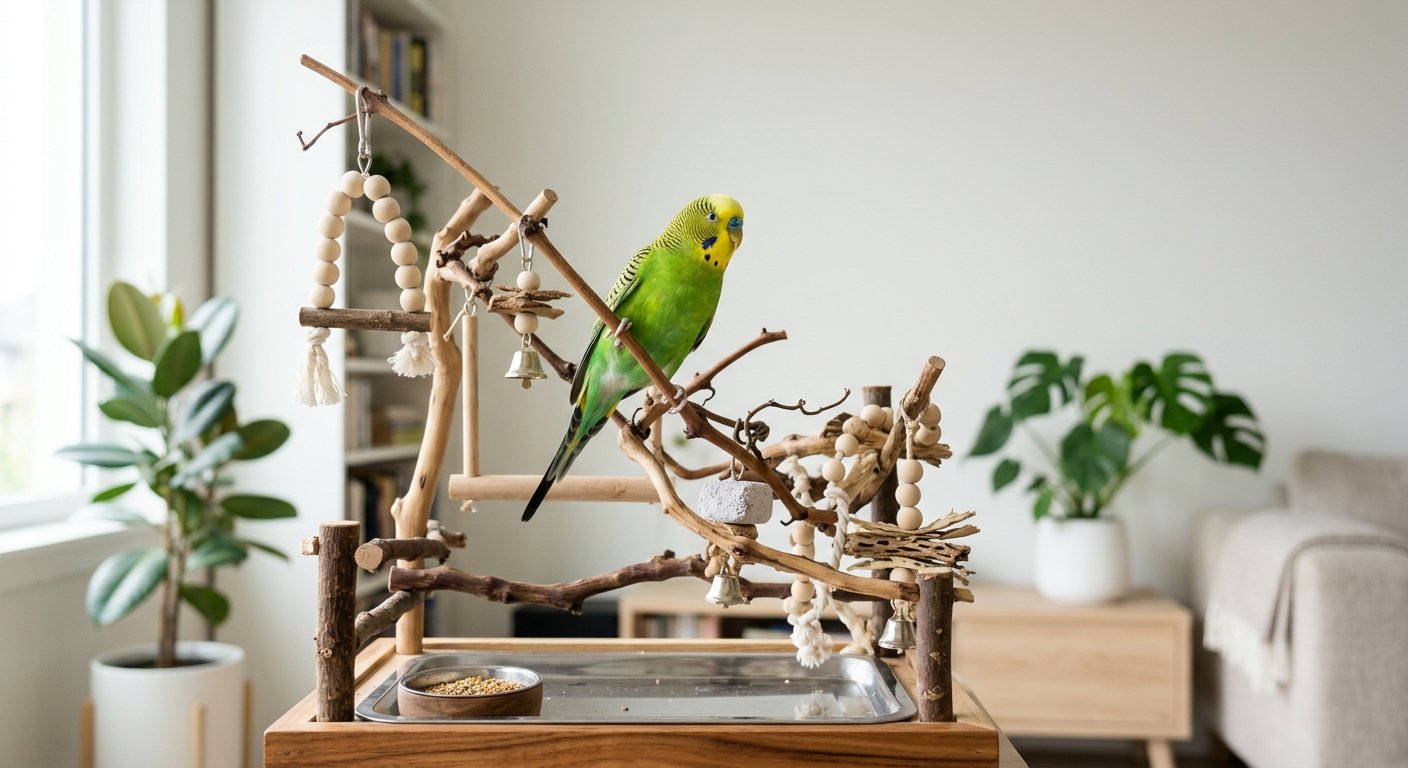
Perches are easy to overlook. Different diameters give the bird’s feet natural variation instead of gripping the same shape all day; worn or damaged perches should just get replaced.
Cleanliness isn’t just cosmetic, a cage that “looks clean” can still have contaminated food and water dishes if they’re not washed regularly.
Veterinary care
Birds are prey animals by instinct, which means they hide illness until they physically can’t anymore. By the time a budgie looks sick, it may have been sick for a while. That’s the core argument for routine exams with an avian vet (the Association of Avian Veterinarians recommends regular checkups) rather than waiting for obvious symptoms.
Weighing your bird periodically at home is a cheap, useful habit, a gradual weight change is nearly impossible to spot by eye through feathers, but it shows up on a scale.
Genetics and history
Some of this is simply out of your hands. Two budgies raised in identical conditions can have very different outcomes because of breeding history, early development, or inherited susceptibility to disease. Good care reduces preventable risk. It doesn’t override biology.
Household hazards people don’t think about
A budgie can never leave the house and still be at real risk because the danger isn’t outdoors, it’s in your kitchen. Birds have extremely sensitive respiratory systems, and fumes from overheated nonstick cookware specifically are flagged by avian vet organizations as a serious hazard. Aerosols and certain cleaning products carry similar risk.
Beyond fumes, most bird injuries happen during out-of-cage time: open windows, ceiling fans, hot stovetops, curious cats. Bird-proof the room before the cage door opens, not after something goes wrong.
Health problems that show up over a budgie’s life
Common issues vets see in budgies include obesity, nutritional deficiencies, liver disease, parasites, tumors, and reproductive complications. As birds age, organ-related conditions — kidney, liver, heart become more likely.
Contact an avian vet if you notice:
- Reduced appetite or trouble eating
- Unexplained weight loss
- Noticeable change in droppings
- Labored or unusual breathing
- Loss of balance or weakness
- Sitting fluffed up for long stretches
- Any sudden shift from the bird’s normal behavior
None of these symptoms point to one specific disease, they’re a signal to get the bird checked, not a checklist for self-diagnosis.
Does an older budgie need different care?
There’s no single age where a budgie “becomes a senior”. Aging is gradual and varies bird to bird. What changes is how closely you should watch things: weight, appetite, droppings, mobility, breathing. Keeping a rough record of a bird’s normal weight makes it much easier to notice a real change later.
One important caveat: don’t assume every slowdown is “just old age.” Older budgies get sick from treatable conditions too, and those get missed more easily if everything unusual gets chalked up to aging.
Can a budgie live to 20?
It happens, but it’s the exception, not something to plan around. Sources don’t fully agree on the ceiling. Merck’s Veterinary Manual lists a narrower 5–10 year range, while PetMD’s broader estimate is 7–15 years, averaging 10–12 with good care. That spread itself is worth noting: these are population estimates, not a fixed number your bird is guaranteed to hit.
Practical takeaway: if you’re getting a budgie, plan for a decade-plus commitment, not a “starter pet for a couple years.”
A realistic care checklist
- Base the diet on formulated pellets, not seed mix alone
- Fresh water daily
- Cage big enough for real movement, not just perching
- Varied, undamaged perches
- Clean food and water dishes regularly
- Track weight periodically
- No smoke, aerosols, or nonstick cookware fumes near the bird
- Bird-proof any room before out-of-cage time
- Routine avian vet checkups, not just when something looks wrong
If you’re comparing budgies with other companion birds before choosing a pet, Best Starter Birds for First-Time Owners is worth a look.
FAQ
How long do parakeets live on average? Typically 7–15 years in captivity, with some living outside that range in either direction.
Is 10 years old for a budgie? It’s a senior bird by most standards, but “old” doesn’t mean declining, a 10-year-old budgie can still have years of good health ahead depending on its history and condition.
Can a parakeet really live 15 years? Yes — that’s within the normal upper range for a well-cared-for captive bird, not an outlier.
Do male and female budgies live different lengths of time? Not in any consistent, predictable way. Genetics, health history, and living conditions outweigh sex as a factor.
Does diet really change lifespan, or is that overstated? It’s a real factor, not a guarantee. Poor diet contributes to disease; a good diet supports normal function — but diet alone doesn’t determine an individual bird’s lifespan.
When should I actually take my budgie to the vet? Any clear deviation from its normal baseline — eating less, breathing oddly, losing weight, wobbling, or just acting “off” for more than a day or two, warrants a call to an avian vet rather than a wait-and-see approach.